
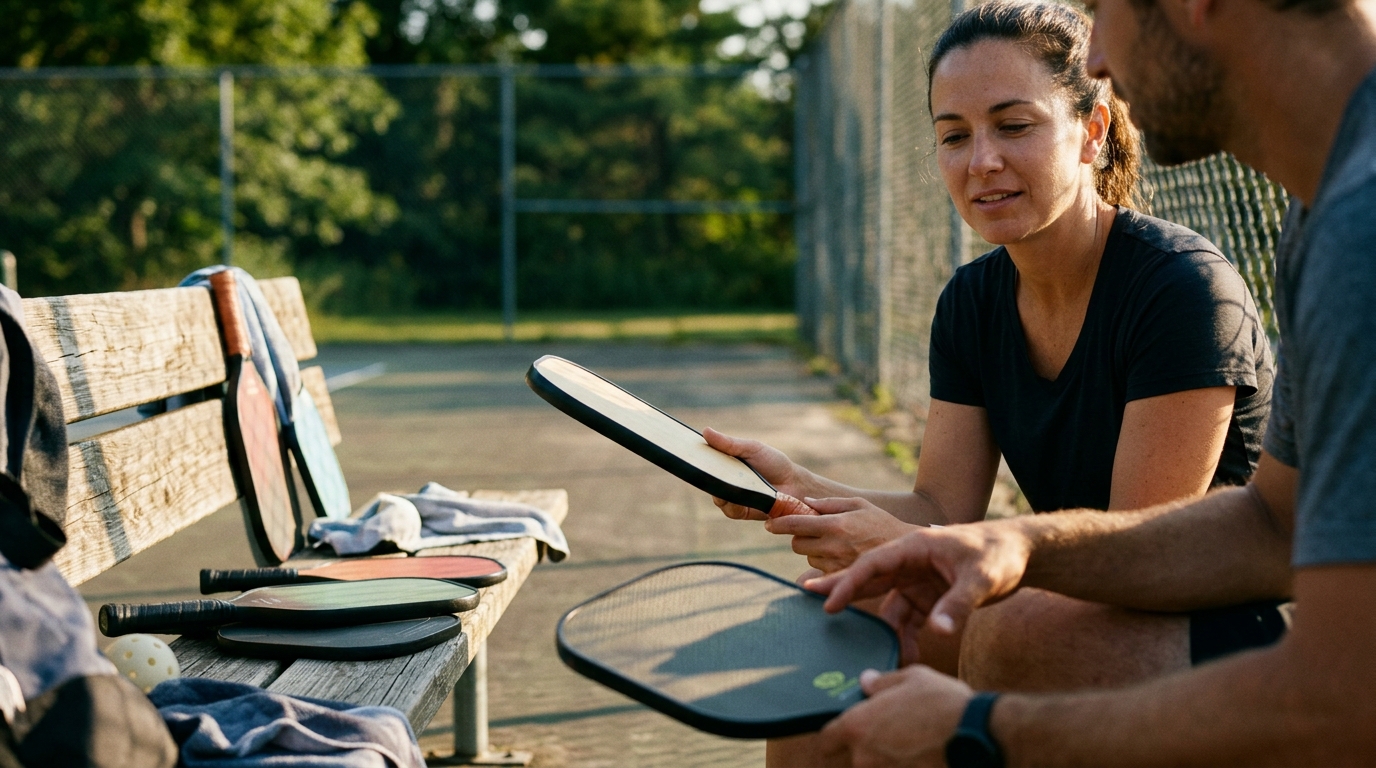
Walk into any pro shop or scroll through an online paddle catalog and you’ll run into dozens of specs: core thickness, face texture, swing weight, balance point, handle length. It’s a lot—and most of it only matters if you know which questions to ask first.
This FAQ-style guide from Godfather Pickleball tackles the real questions players bring to the checkout page—from foundational choices like weight and shape all the way to 2026-era innovations like foam cores, durable grit surfaces, and quiet paddle designs. Bookmark it, reference it mid-shop, and walk away confident that the paddle in your cart actually fits your game.
Weight & Balance: The First Thing You Should Decide
How much should a pickleball paddle weigh?
Most pickleball paddles hover around eight ounces, but the range spans roughly 6.8 oz to 9+ oz. Selkirk groups paddles into three tiers: lightweight (under 7.2 oz) for quick maneuverability and net play, midweight (7.3–8.4 oz) for balanced all-around performance, and heavyweight (8.5+ oz) for maximum power with reduced finesse. The midweight category remains the most popular choice for the majority of players.
Does heavier always mean more power?
In physics terms, yes—more mass behind the swing increases force at contact. But a heavier paddle slows hand speed, which matters in fast exchanges at the kitchen line. If you come from tennis, heavier paddles often feel natural; former racquetball players may prefer lighter options. The key is finding the weight that lets you swing confidently on offense without sacrificing reaction time on defense.
What about swing weight vs. static weight?
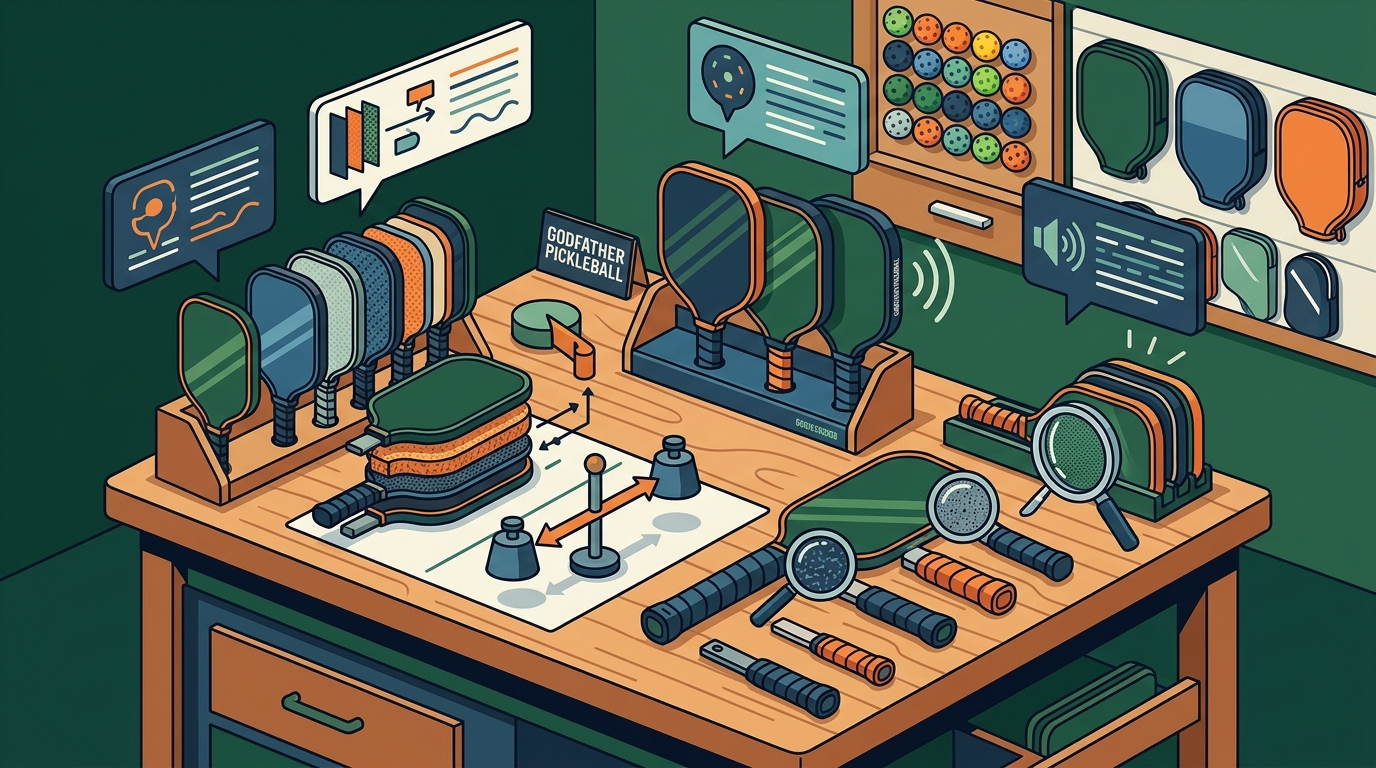
Static weight is the number on your scale. Swing weight measures how the paddle’s mass distribution affects rotational inertia around your wrist. Two paddles at identical static weights can feel completely different depending on where the weight sits—head-heavy paddles drive more power, handle-heavy paddles accelerate faster through the hitting zone. Even a 1-gram difference in edge weighting can shift swing weight by 8–12 points, significantly altering paddle feel.
Core Material & Thickness: The Engine Inside Your Paddle
What core materials are available?
For most of pickleball’s history, paddles relied on polypropylene (PP) honeycomb cores—a lightweight plastic grid sandwiched between composite faces. PP cores are affordable and effective, but they can compress over time and offer inconsistent feel across the sweet spot. In 2026, foam core technology—especially full-foam or foam-enhanced designs—dominates the conversation. Dense foam cores provide more consistent energy return, less vibration, and broader sweet spots. This is the biggest material shift in paddles in years, affecting everything from power transfer to ball control.
How does core thickness change performance?
Paddles come in thicknesses from roughly 8 mm to 20 mm. The general rules:
- Thinner cores (typically 14 mm) deliver more “pop” and rebound—manufacturers often label these as power paddles. They tend to have a smaller sweet spot and reward precise technique, making them more common among advanced players.
- Thicker cores (typically 16 mm) distribute force more evenly, make controlling the ball easier, and produce a more consistent sweet spot across the face. Shots feel more predictable, which benefits players at every level.
Many top models in 2026 ship in both 14 mm and 16 mm configurations so you can test which thickness matches your game. The RPM Friction Pro, for instance, offers four core configurations: 16 mm elongated, 14 mm elongated, 16 mm widebody, and 14 mm widebody.
Shape & Dimensions: Reach vs. Forgiveness
What paddle shapes exist?
Three main shapes dominate the market:
- Standard / widebody – The classic shape with a broad face, generous sweet spot, and balanced feel. Suitable for any skill level and especially forgiving on off-center hits.
- Elongated – A narrow body with a length of 16 inches or longer. These paddles add reach and power but move the sweet spot slightly higher on the face and reduce its overall size.
- Hybrid – Splits the difference, offering a slightly extended face without fully sacrificing width. Increasingly popular among intermediate players stepping up to competitive play.
Are there size regulations?
Yes. According to USA Pickleball regulations, the combined length and width of a paddle—including edge guard and butt cap—cannot exceed 24 inches. Manufacturers adjust dimensions within that envelope to deliver different performance profiles.
Face Material & Spin: What Meets the Ball
Which face materials are common?
The three primary face materials are:
- Fiberglass (composite) – Offers a softer feel and good power; common on budget-friendly paddles.
- Graphite – Lightweight and stiff, providing fast response and solid control.
- Carbon fiber (raw or textured) – The 2026 standard for performance paddles. Raw carbon surfaces maximize spin through surface grit and texture.
How important is surface texture for spin?
Extremely. Textured paddle faces grip the ball and create more rotation on every stroke. But grit degrades with play, which is why surface durability has become a major differentiator. Long-lasting grit means consistent performance over hundreds of hours of play rather than a paddle that feels amazing for the first week and then flattens out. Brands are now engineering faces where texture longevity matters as much as initial spin potential.
Grip Size & Handle Length: Comfort Meets Control
What grip size do I need?
Most adult pickleball paddles range from 4.0 to 4.5 inches in grip circumference. Getting the correct size reduces strain on your hand, wrist, and elbow while giving you better control. A grip that’s too small forces you to squeeze harder (hello, forearm fatigue); a grip that’s too large limits wrist snap and spin generation.
A simple home measurement: use a ruler to measure from the middle crease of your palm to the tip of your ring finger. That measurement maps roughly to your ideal circumference. When in doubt, go slightly smaller—you can always build up with an overgrip, but making a grip smaller is more involved.
Does handle length matter?
Absolutely. Longer handles (5.5 inches or more) give you room for a two-handed backhand and added leverage on serves. Former tennis players often gravitate toward extended handles. Standard handles suit one-handed play and keep the hitting surface as large as possible within the 24-inch limit.
Sweet Spot & Forgiveness: Where Consistency Lives
What is the sweet spot, exactly?
The sweet spot is the area on the paddle face where contact produces the most power and the most accurate ball response with the least vibration in your hand. It’s technically the center of percussion—a physics concept tied directly to weight distribution.
How do I get a bigger sweet spot?
Several design choices expand it:
- Wider paddle face – More surface area naturally increases the forgiving zone.
- Thicker core – Distributes force more evenly.
- Higher twist weight (MOI) – Paddles with weight distributed toward the perimeter resist twisting on off-center hits, making the sweet spot feel larger. Proper weight placement can expand your effective sweet spot by up to 30 percent.
- Foam cores – The consistent energy return of dense foam extends the reliable hitting zone compared to traditional honeycomb.
Noise & Community Considerations
Do quieter paddles perform differently?
Quiet paddle technology has evolved from a noise-restriction workaround into a legitimate performance category. Modern quiet designs use materials and construction that absorb sound rather than amplify it. The result is a more muted, controlled feel on contact that can also benefit your wrist and arm comfort. Look for paddles with thicker cores and softer carbon fiber or graphite faces if noise is a concern for your local courts.
Price, Durability & Value
How much should I spend?
Paddles range from under $50 for entry-level options to $300+ for pro-level builds. The sweet spot for most recreational-to-competitive players falls between $100 and $200. Brands like Vatic Pro have proven that high-level performance doesn’t require a premium price tag, while top-end paddles from JOOLA or Selkirk deliver refined feel that serious players find worth the investment.
How long does a paddle last?
It depends on frequency. Competitive players who play daily typically retire a carbon fiber or composite paddle after three to six months. Recreational players hitting the courts a couple of times a week can expect one to three years of solid performance. Surface grit tends to wear first, gradually reducing spin generation before the core or structure gives out.
Common Mistakes to Avoid
- Buying too much power for your level. The biggest mistake many players make is choosing a paddle that’s too powerful for their current skill set. Control and consistency win more points than raw pop.
- Ignoring grip size. A mismatched grip leads to overgripping, fatigue, and even elbow injuries. Measure before you buy.
- Chasing specs instead of feel. Spec sheets tell part of the story, but on-court testing reveals how a paddle actually performs in your hand. Demo programs and trial periods exist for a reason.
- Skipping the weight question. Weight and balance affect every single shot. A paddle that’s too heavy or too light for your natural swing tempo fights you on every rally.
- Overlooking surface durability. A paddle that spins beautifully on day one but loses grit by month two is a poor long-term investment.
Key Takeaways
- Start with weight and shape—these two choices filter out 80% of the market immediately.
- Core thickness is the power-vs-control lever—thinner cores add pop, thicker cores add forgiveness and consistency.
- Foam cores are the defining technology of 2026, offering broader sweet spots, less vibration, and more controlled energy transfer than traditional honeycomb.
- Surface texture durability matters more than peak spin—look for faces that maintain grit over months of play.
- Grip size directly affects comfort and injury risk—measure your hand and size accordingly.
- On-court testing beats spec-sheet shopping—demo paddles whenever possible before committing.
- Browse the full paddle collection at Godfather Pickleball to compare specs side by side and find your match.
Frequently Asked Questions
What is the most important feature when buying a pickleball paddle?
Weight and balance are the most impactful starting points because they affect every shot you take—power, control, hand speed, and fatigue. Once you nail the right weight range, decisions about core thickness, shape, and face material become much easier to make.
What paddle weight is best for beginners?
Most beginners do well with a midweight paddle between 7.3 and 8.0 ounces. This range provides enough mass for stable shots without the fatigue that heavier paddles can cause during long sessions. Pair it with a thicker core (16 mm) for a forgiving sweet spot.
What is the difference between a 14 mm and 16 mm core?
A 14 mm core is thinner and produces more rebound (“pop”), favoring power-oriented players with precise technique. A 16 mm core distributes force more evenly, offering better control, a larger sweet spot, and more predictable shot response. Many competitive paddles ship in both options so you can choose based on your playing style.
Are foam core paddles better than honeycomb?
Foam cores offer more consistent energy return, less vibration, and broader sweet spots compared to traditional polypropylene honeycomb. They represent the biggest material shift in paddle technology in recent years. However, “better” depends on your priorities—some players prefer the classic pop and lighter weight of honeycomb designs.
How do I measure my grip size for a pickleball paddle?
Measure from the middle crease of your palm to the tip of your ring finger using a ruler. That measurement (in inches) approximates your ideal grip circumference. Most adult paddles range from 4.0 to 4.5 inches. If you fall between sizes, choose the smaller option and add an overgrip to fine-tune the fit.
Does paddle shape affect the sweet spot?
Yes. Wider, standard-shaped paddles have a larger sweet spot that’s more forgiving on off-center hits. Elongated paddles shift the sweet spot slightly higher and reduce its overall size, but they add reach and power. Hybrid shapes offer a middle ground between forgiveness and extension.
How often should I replace my pickleball paddle?
Competitive players who play daily often replace paddles every three to six months as surface grit wears down. Recreational players typically get one to three years of use. Monitor your spin performance and feel—when shots start sliding off the face without bite, it’s time for a fresh paddle.
Where can I buy pickleball paddles online?
Godfather Pickleball offers a curated selection of pro-tested paddles, shoes, and gear for players of all levels. Every product is vetted for quality and performance so you can shop with confidence.