With 24.3 million Americans playing pickleball in 2025 and participation up 171.8% over three years, choosing the right paddle has never mattered more. Whether you are stepping onto a court for the first time or grinding through tournament brackets, the paddle in your hand shapes every dink, drive, and overhead you hit. This guide breaks down the technology, features, and real-world performance factors that separate a good paddle from a great one so you can find the best pickleball paddle for your game, skill level, and budget.
Why Your Paddle Choice Matters More Than Ever
Pickleball is no longer a niche backyard game. According to the Sports & Fitness Industry Association (SFIA), 24.3 million Americans played pickleball in 2025, a 22.8% year-over-year increase that made it the fastest-growing sport in the country. With that kind of growth, manufacturers are investing heavily in paddle research and development.
The result is a market flooded with options. USA Pickleball approved 718 new paddles in 2025 alone. So how do you cut through the noise? It starts with understanding the features that actually affect on-court performance.
Key Features That Define a Top Pickleball Paddle
Face Material
A paddle face is the outer striking surface that contacts the ball. In 2026, T700 carbon fiber dominates the premium segment. As explained on the Godfather Pickleball Boss paddle page, Toray T700 carbon fiber delivers unmatched durability, superior spin, and a consistent feel across the entire face. Textured carbon grips the ball longer for maximum spin potential and precise shot placement.
Core Thickness
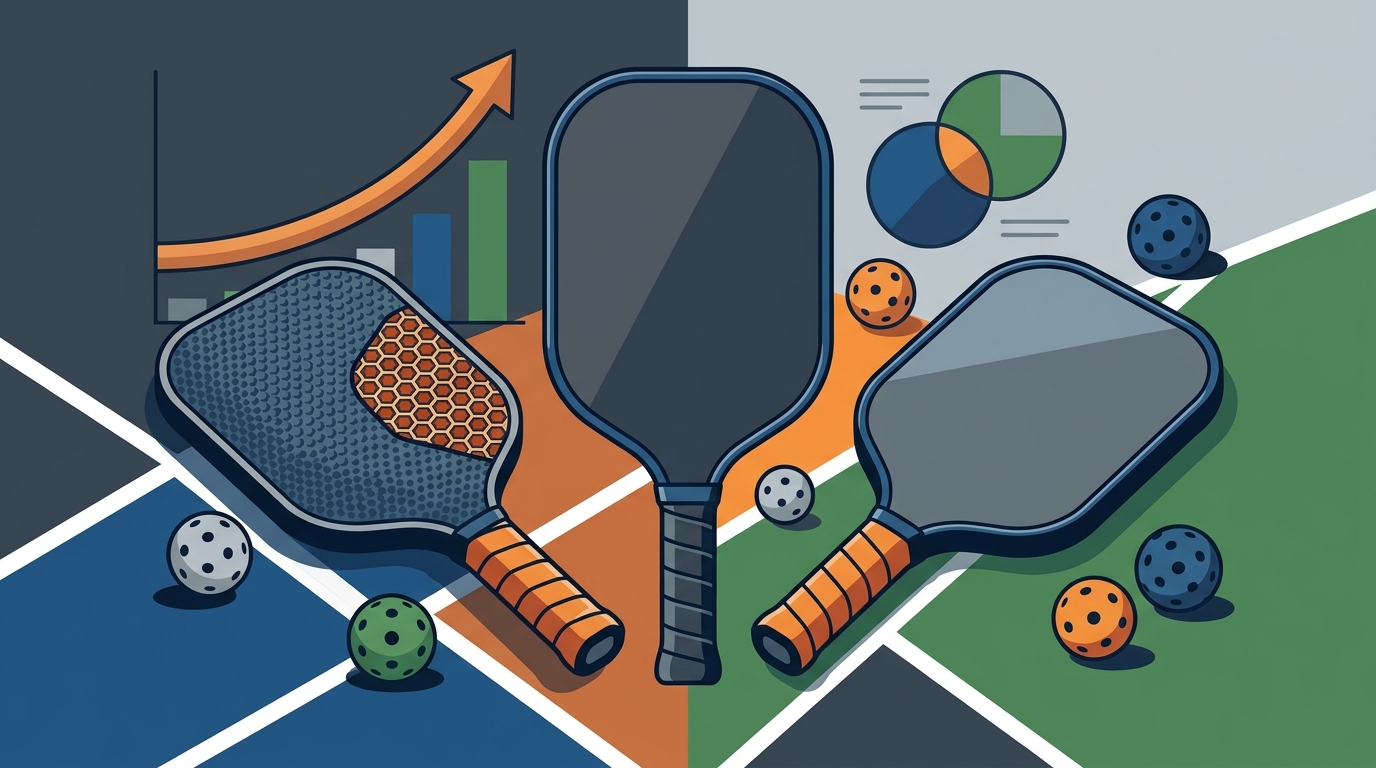
Core thickness is the measurement, in millimeters, of the internal honeycomb or foam layer that dictates power and control. Thinner cores (13-14 mm) produce more immediate pop, while thicker 16 mm cores increase dwell time and forgiveness on off-center hits. Many players find that a 16 mm core offers the best balance for all-around play.
Weight and Balance
Midweight paddles in the 7.8-8.4 oz range tend to balance pace generation with hand speed at the kitchen line. Head-heavy paddles generate more momentum, while handle-heavy paddles trade raw power for maneuverability.
Core Technology: Honeycomb vs. Foam
A paddle core is the internal structure sandwiched between the face layers that determines energy return, vibration dampening, and sweet spot size. For most of pickleball's history, polypropylene honeycomb cores were the standard. They remain effective and affordable, but they can compress over time.
Full-foam and foam-enhanced cores have reshaped the 2026 landscape. As covered in Godfather Pickleball's power paddle guide, Gen-4 foam paddles deliver a unified feel from edge to edge with fewer dead zones and more predictable feedback. They can hit hard on a full drive while still giving you the touch to reset at the kitchen line.
With the UPA-A's PEF compliance standard now enforced at sanctioned play, paddle makers must maximize power within regulated limits through smarter engineering rather than brute force.
Paddle Comparison by Player Level
Not every paddle suits every player. The table below maps common paddle archetypes to skill levels so you can narrow your search quickly.
| Player Level | Recommended Core | Ideal Thickness | Face Material | Priority Trait | Price Range |
|---|---|---|---|---|---|
| Beginner (2.0-3.0) | Polypropylene honeycomb | 16 mm | Fiberglass or carbon composite | Forgiveness & large sweet spot | $50-$120 |
| Intermediate (3.5-4.0) | Foam-enhanced hybrid | 14-16 mm | T700 carbon fiber | Spin & control balance | $120-$200 |
| Advanced (4.5-5.0+) | Full foam or dense polymer | 13-16 mm (player preference) | Raw or textured T700 carbon | Power within PEF limits | $180-$330 |
The $100-$200 tier is widely considered the sweet spot for most players in 2026. Advanced materials that looked premium 18 months ago have trickled down into this range, making it one of the best years ever to be a price-conscious player.
What Pro Players Actually Look For
Professional athletes prioritize three things: spin consistency, sweet spot stability, and a paddle that complements their specific style. At Godfather Pickleball, the team spent years working directly with over 100 elite players before launching their own paddle line, learning what separates a good paddle from a game-changing one.
PPA competitor Gabe Tardio, who partners with World No. 1 Ben Johns, trusts the PIKKL Vantage Pro. His feedback, along with insights from athletes like Kate Fahey and Dusty Boyer, shaped the engineering behind paddles like The SmokeShow and The Boss.
The takeaway for recreational players: look for paddles built with direct pro input, not just pro endorsement logos slapped on generic designs.
Best Value Paddles in 2026
You do not need to spend $300 to play at a high level. The performance gap between a $99 paddle and a $250 paddle has narrowed significantly. Brands now deliver specs that looked premium 18 months ago at mid-tier prices.
Godfather Pickleball's own line exemplifies this approach. By sourcing the same T700 carbon and polymer cores as brands charging $250-$280, then cutting retail overhead, they deliver pro-level technology at accessible prices with a 60-day risk-free trial.
When evaluating value, consider durability alongside sticker price. Longer-lasting surface grit is now table stakes at the premium level, meaning your paddle's spin performance will hold up longer than models from even two years ago.
Key Takeaways
- There is no single "best" paddle for everyone. The right paddle depends on your skill level, play style, and budget.
- T700 carbon fiber faces and foam-enhanced cores represent the current performance standard across price tiers.
- Thicker cores (16 mm) offer more forgiveness and control; thinner cores (13-14 mm) deliver more pop and power.
- The $100-$200 price range now delivers advanced materials that were considered premium just 18 months ago.
- Pro-tested paddles built from real athlete feedback outperform generic designs with celebrity endorsement stickers.
- PEF compliance is mandatory for sanctioned play in 2026, so always verify your paddle meets current regulations.
- A 60-day trial, like Godfather Pickleball offers, lets you test a paddle in real match conditions before committing.
Frequently Asked Questions
What is the best pickleball paddle for beginners in 2026?
Beginners should look for a 16 mm paddle with a large sweet spot and forgiving construction. Fiberglass or carbon composite faces paired with a polypropylene honeycomb core provide solid performance without a steep learning curve. Paddles in the $50-$120 range cover this category well.
Does core thickness really affect performance?
Yes. Thinner cores (13-14 mm) produce faster pop and more immediate power, making them popular among aggressive players. Thicker 16 mm cores add dwell time, which improves control, forgiveness, and the ability to shape shots with spin.
What is T700 carbon fiber and why does it matter?
T700 carbon fiber is a high-grade Toray fiber used in premium paddle faces. It provides a high-friction surface for maximum spin, exceptional durability under repeated impact, and a consistent response across the entire hitting area.
How much should I spend on a pickleball paddle?
Most players find their best value between $100 and $200. This tier now includes advanced materials like foam-enhanced cores and T700 carbon faces. Premium paddles above $200 offer incremental gains that matter most for competitive tournament players.
What is the difference between pop-based and dwell-based power?
Pop-based paddles launch the ball off the face almost instantly with a crisp, fast feel. Dwell-based paddles hold the ball a fraction longer, letting the core compress and spring forward, which also allows more spin and shot-shaping. Your swing style determines which type suits you.
Are foam-core paddles better than honeycomb?
Foam cores offer more consistent energy return, less vibration, and broader sweet spots compared to traditional honeycomb. However, honeycomb cores remain effective and are often more budget-friendly. Neither is universally "better"; it depends on your priorities.
How do I know if a paddle is legal for tournament play?
Check that the paddle is USA Pickleball Approved and meets the current PEF (Paddle Evaluation Framework) standard. In 2025, USA Pickleball's Equipment and Evaluation Committee tested and approved 718 paddles from 193 new manufacturers.
Can I try a paddle before buying?
Many retailers now offer trial programs. Godfather Pickleball provides a 60-day risk-free trial on their paddle line, so you can test on-court performance before making a final decision.
Find Your Perfect Paddle
Ready to upgrade your game? Browse the full Godfather Pickleball paddle collection, featuring pro-tested paddles engineered from years of elite athlete feedback and backed by a 60-day risk-free trial. Find the paddle that fits your play style, skill level, and budget today.