Choosing the right pickleball paddle can feel overwhelming when hundreds of options crowd the market. With 24.3 million Americans playing pickleball in 2025 and participation up nearly 172% in just three years, demand for high-performance paddles has never been higher. Whether you are a casual weekend player or a tournament competitor, the paddle in your hand directly shapes your power, spin, and control. This guide breaks down the technologies, specs, and real-world considerations that determine which pickleball paddle truly earns the title of top choice for performance across all player levels.
Why Your Paddle Choice Matters More Than Ever
Pickleball is no longer a backyard novelty. The SFIA called pickleball "the dominant multi-year growth leader across all tracked sports" in its 2026 report. That surge means paddle engineering has advanced at a pace that rivals tennis racket R&D.
A performance paddle is a paddle engineered to maximize power, spin, and control through advanced materials and construction methods. The difference between a budget starter and a purpose-built performance paddle shows up in every dink, drive, and overhead you hit.
Key Paddle Technologies Shaping 2026
Foam-Core Construction
Gen-4 foam cores have transformed paddle feel. As the team at Godfather Pickleball explains in their power paddle guide, full-foam and foam-enhanced cores provide more consistent energy return, less vibration, and broader sweet spots compared to traditional polypropylene honeycomb. These cores also resist performance degradation over time.
Carbon Fiber Faces
Toray T700 carbon fiber is the gold standard in the industry. A T700 face delivers superior spin and control because the textured carbon surface grips the ball longer, giving you maximum spin potential and precise shot placement. Raw carbon produces a crisper, more powerful response, while textured carbon adds spin that pulls the ball down faster on drives.
Compliance and Regulation
UPA-A's PEF standard is now fully enforced at sanctioned play. The best 2026 paddles maximize power within the regulated ceiling through smarter core engineering and face construction rather than brute force. Always verify that your paddle is USA Pickleball Approved before competing.
What to Look for in a Performance Paddle
Core thickness is one of the most important specs to understand. Thinner cores (13 to 14 mm) generally produce more immediate pop, while thicker 16 mm cores increase dwell time and offer better forgiveness on off-center hits. Dwell time is the duration the ball stays on the paddle face before launching, and it directly affects how much spin and angle you can apply.
Weight matters too. Paddles in the 8.0 to 8.4 oz midweight range tend to balance pace generation with the hand speed you need at the kitchen line. Head-heavy designs generate more momentum through the swing arc, while balanced or handle-heavy paddles trade raw power for maneuverability.
Swing weight is the measure of how heavy a paddle feels during a swing, factoring in weight distribution rather than static weight alone. Independent reviewers now measure swing weight, twist weight, and balance point using calibrated equipment for reliable comparisons.
Top Performance Paddles Compared
The table below compares popular paddle archetypes and what each offers across the performance spectrum.
| Paddle Archetype | Best For | Core Type | Thickness | Primary Strength |
|---|---|---|---|---|
| Power Drive (e.g., The Boss by Godfather Pickleball) | Aggressive players | Polymer honeycomb | 8-10 mm | Explosive pop and fast hands |
| Spin & Precision (e.g., The SmokeShow by Godfather Pickleball) | Shot shapers | Polymer honeycomb | 8-10 mm | Maximum spin and sharp angles |
| All-Court Foam | Versatile competitors | Full foam | 16 mm | Large sweet spot and dwell time |
| Control Hybrid | Beginners to intermediate | Foam-enhanced honeycomb | 14-16 mm | Forgiveness and consistency |
| Elongated Power | Singles and reach | Foam or poly | 13-14 mm | Leverage and plow-through |
No single paddle is universally perfect. As Pickleball Effect notes after testing hundreds of paddles, there is not one paddle that works for everyone, but there is one that fits your game.
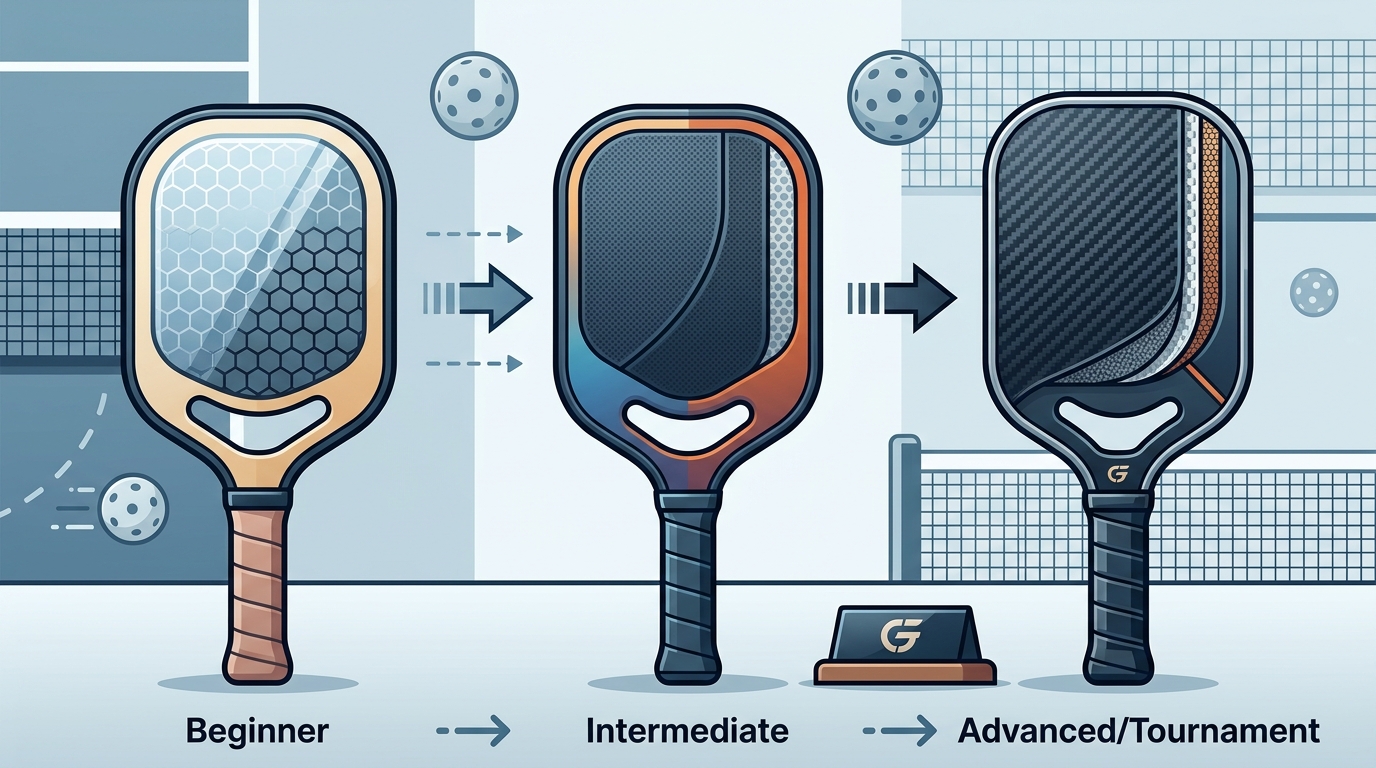
Matching a Paddle to Your Skill Level
Beginners (2.0 to 3.0)
New players benefit most from a wider paddle face, a forgiving sweet spot, and a midweight build. A thicker core (14 to 16 mm) smooths out inconsistent contact. The Boss widebody shape is designed to deliver ultra-fast hands at the net without sacrificing power, making it approachable for newer players who want room to grow.
Intermediate (3.5 to 4.0)
At this stage, players develop shot preferences and benefit from a paddle that rewards technique. A spin-oriented option like The SmokeShow combines a gritty T700 carbon surface with a thinner polymer core for faster response and sharper angles. Intermediate players often see the biggest jumps in performance when they upgrade from a generic paddle to one matched to their play style.
Advanced and Tournament (4.5+)
Competitive players need a paddle that can execute every shot in the modern game. The $100 to $200 tier is the sweet spot for most players in 2026, offering advanced materials and construction quality that meaningfully enhance performance. Advanced players should also look for paddles that comply with the latest PEF regulations and offer long-lasting surface grit for sustained spin.
The Pro-Tested Advantage
Godfather Pickleball was built from the inside of the pro circuit. The company started as a talent agency representing over 100 elite players before launching its own paddle line. As the About Us page explains, through years of conversations, contracts, and countless hours on court with the pros, the team learned what separates a "good" paddle from a game-changing one.
That means every Godfather paddle is engineered with precision, tested for performance, and priced so players can compete at the highest level without compromise. The brand sources the same T700 carbon and polymer cores as brands charging $250 to $280 but skips the retail markup. A 60-day risk-free trial lets you test any paddle in real play before committing.
Key Takeaways
- There is no single "best" paddle for everyone. The top choice depends on your skill level, play style, and budget.
- Gen-4 foam and foam-enhanced cores deliver broader sweet spots, more consistent energy return, and better durability than traditional honeycomb alone.
- Toray T700 carbon fiber remains the gold standard for spin, durability, and consistent feel across the paddle face.
- Core thickness directly controls the pop-versus-dwell tradeoff: thinner cores favor power, thicker cores favor control and forgiveness.
- The $100 to $200 price range offers the best performance-to-value ratio for most players in 2026.
- Always verify USA Pickleball Approved status and PEF compliance before tournament play.
- Pro-tested paddles built with insider knowledge, like those from Godfather Pickleball, can deliver elite-level technology at accessible prices.
Frequently Asked Questions
What is the best pickleball paddle for beginners in 2026?
Beginners should look for a widebody paddle with a forgiving sweet spot and a core thickness of 14 to 16 mm. Options like The Boss offer a large hitting surface and stable weight distribution that help new players build confidence while still delivering enough power to grow into.
How does core thickness affect paddle performance?
Thinner cores (13 to 14 mm) produce faster, more immediate pop for aggressive play. Thicker cores (16 mm) increase dwell time, letting you shape shots with more spin and angle while offering better forgiveness on off-center hits.
What is the difference between pop-based and dwell-based power?
Pop-based paddles launch the ball off the face almost instantly, rewarding compact swings with immediate pace. Dwell-based paddles hold the ball slightly longer, letting the core compress and spring forward. Learn more in our pop and power paddle guide.
Why is T700 carbon fiber considered the best face material?
Toray T700 carbon fiber offers unmatched durability, a uniform weave for a predictable response across the entire face, and a textured surface that grips the ball for maximum spin potential. It is the most widely used face material on top-performing paddles.
Are expensive paddles always better?
Not necessarily. The performance gap between a $99 paddle and a $250 paddle has narrowed significantly in 2026. Brands like Godfather Pickleball deliver pro-level specs by cutting retail overhead, proving that price alone does not determine quality.
How many Americans play pickleball now?
According to the SFIA's 2026 report, 24.3 million Americans played pickleball in 2025, a 22.8% year-over-year increase and a 171.8% jump over three years.
Does Godfather Pickleball offer a trial period?
Yes. Godfather Pickleball provides a 60-day risk-free trial. Play with the paddle, test it in competition, and return it within 60 days for a full refund if it is not the right fit.
What paddle do pro players recommend?
Preferences vary by play style, but many pros prioritize T700 carbon faces, foam or foam-enhanced cores, and elongated shapes for reach. PPA competitor Gabe Tardio trusts the PIKKL Vantage Pro, available through Godfather Pickleball.
Find Your Perfect Paddle
Ready to upgrade your game with pro-tested technology at a fair price? Browse the full Godfather Pickleball paddle collection and take advantage of the 60-day risk-free trial. Your next level of play is one paddle away.