When Anna Leigh Waters signed a paddle deal with Franklin worth more than $10 million over three years, that money didn't come from thin air. It came from the retail price of every Franklin paddle sold. The same is true for Ben Johns' lifetime JOOLA contract, estimated at roughly $1 million per year in base pay plus $500,000 or more in royalties on Perseus paddle sales. Every signature paddle you see on a pro tour broadcast has a sponsorship line item baked into its shelf price — and understanding that line item is the first step toward buying smarter.
This guide walks you through the endorsement economics that drive premium paddle pricing, shows you what actually matters in paddle construction, and gives you a practical roadmap for getting pro-quality gear at a price that makes sense.
How Endorsement Deals Inflate Paddle Retail Prices
Professional pickleball sponsorships follow a steep pyramid. At the very top, Anna Leigh Waters grosses an estimated $6.6 million in 2026 and Ben Johns grosses roughly $4.8 million. Their paddle deals are the single largest income line after league pay. Below them, an A-tier player's paddle contract averages around $750,000 per year, while mid-tier touring pros earn between $10,000 and $40,000 annually from paddle endorsements.
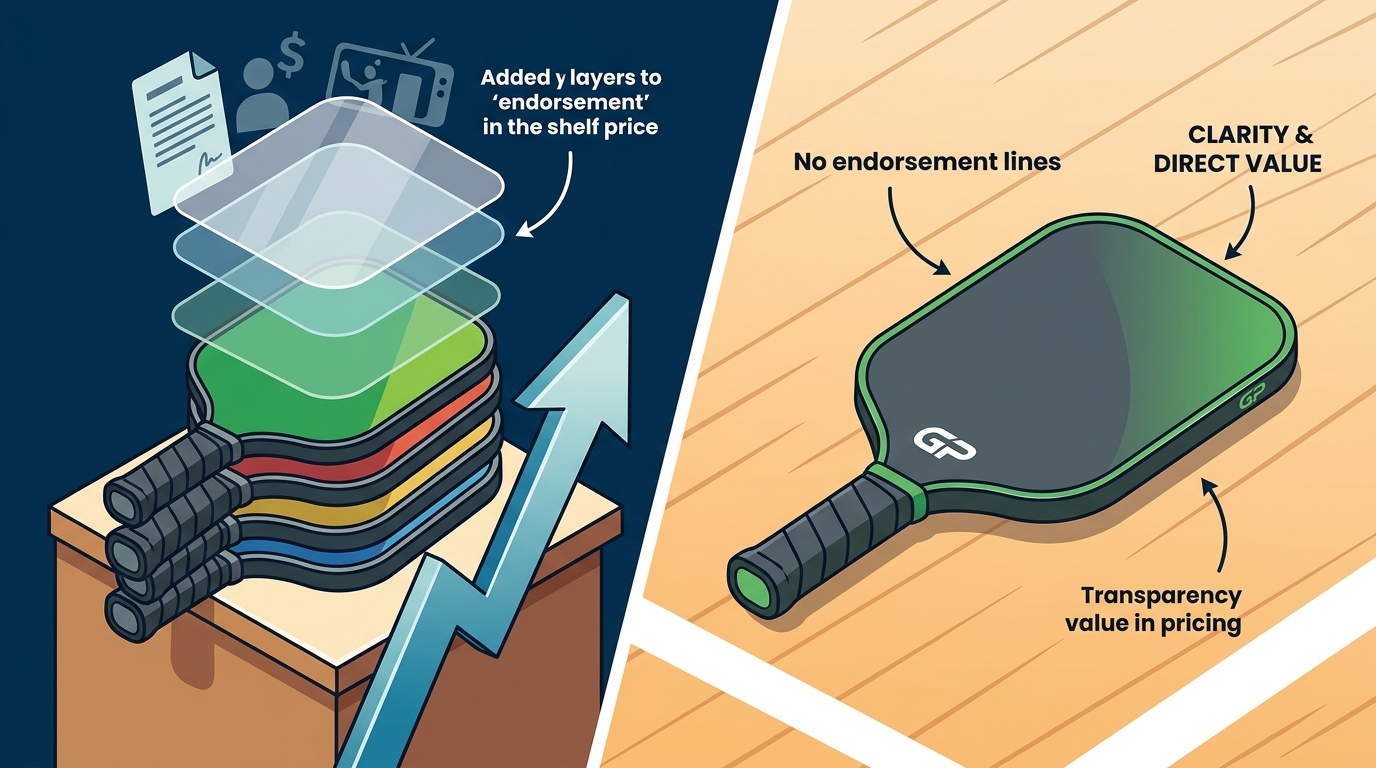
All of these costs — plus the marketing, social media campaigns, and tournament activations that surround them — are ultimately funded by retail margins. When professional endorsement contracts across the sport rose by 38 percent between 2023 and 2024 alone, that spending had to be recovered somewhere. It was recovered from you, the consumer.
Consider the math: if a brand signs five touring pros at $50,000 each and sells 20,000 paddles a year, that is $12.50 per paddle just for athlete sponsorships before a single dollar goes toward materials, manufacturing, or shipping.
What You Are Actually Paying for in a $250+ Paddle
A premium pickleball paddle's retail price typically contains four cost layers:
| Cost Layer | Estimated Share of Retail Price |
|---|---|
| Raw materials and manufacturing | 20–30% |
| Brand marketing and pro endorsements | 25–35% |
| Distribution and retail margin | 20–30% |
| R&D and compliance testing | 10–15% |
The materials themselves — T700 or T1100 carbon fiber faces, polypropylene honeycomb or foam cores, thermoformed unibody construction — are increasingly commoditized. Thermoformed paddle construction grew significantly between 2023 and 2024, with 48 percent of premium paddles now incorporating unibody designs. When the production technique is widespread, the raw cost per unit drops. What keeps prices high is everything that happens after the paddle leaves the factory.
Why the Performance Gap Between Price Tiers Is Shrinking in 2026
This is the most important trend working in your favor. The performance delta between a $99 paddle and a $250 paddle has narrowed significantly in 2026. Brands like Vatic Pro and value lines from Selkirk now deliver specifications that looked premium just 18 months ago.
Several factors are driving this convergence:
- Material trickle-down: Over 65 percent of paddles launched in 2024 featured carbon fiber or graphite surfaces, making advanced face materials standard across price points.
- Foam core adoption: What started as a premium-only experiment in 2024–2025 is now baseline at $150 and above.
- Regulatory leveling: The UPA-A's new PEF standard, now fully enforced at sanctioned play, caps raw power output. Paddle makers can no longer engineer outsized performance advantages through brute construction alone — smarter core engineering and face design matter more than ever.
- Manufacturer competition: In 2024, USA Pickleball approved 1,225 new paddles and welcomed 476 new manufacturers. More competition means better products at lower prices.
The $100–$200 tier is the sweet spot for most players in 2026, offering advanced materials and construction quality that meaningfully enhance performance without the endorsement tax of flagship models.
Six Strategies to Buy Pro-Level Paddles Without Overpaying
1. Shop Curated Online Retailers That Negotiate Directly With Brands
Specialty pickleball e-commerce stores like Godfather Pickleball focus exclusively on the sport, which means they can curate pro-tested inventory without the overhead of big-box retail. When an online retailer specializes in one category, they typically maintain tighter relationships with brands and pass better pricing to customers. Look for retailers that stock paddles across multiple price tiers and offer transparent descriptions of construction materials, core thickness, and USA Pickleball approval status.
2. Target Paddles With Pro-Identical Construction but No Signature Branding
Many brands produce a signature paddle alongside a non-signature sibling that uses identical or near-identical construction. The difference? The signature model carries the pro's name and a $30–$80 premium. Ask the retailer or check product specs: same carbon fiber grade, same core material, same thickness. If the specs match, the on-court performance matches.
3. Buy During Product Cycle Transitions
The paddle market moves fast — new paddle launches increased by 49 percent between 2023 and 2024. When a brand releases a new generation, the previous model drops in price while still carrying the same USA Pickleball approval stamp. A 2025 flagship at 40 percent off outperforms a 2026 entry-level paddle at full price in nearly every measurable category.
4. Look for Direct-to-Consumer Brands That Skip the Distribution Layer
Brands that sell directly to players eliminate the wholesale-to-retail markup, which can be as high as 50 percent. Some wholesale programs openly advertise margins of up to 50 percent for resellers — which means the retail price is roughly double the wholesale cost. When a brand cuts out that middle layer, the savings can be dramatic. Check whether the brand discloses its supply chain and whether paddles ship from the company directly.
5. Prioritize USA Pickleball or UPA-A Approved Paddles
Approval status is a non-negotiable quality signal. It means the paddle has passed standardized testing for dimensions, surface texture, deflection, and (now) PEF compliance. Any approved paddle — whether it costs $89 or $289 — meets the same regulatory floor. You do not need a $300 paddle to play in sanctioned tournaments.
6. Evaluate Total Cost of Ownership, Not Just Sticker Price
Over 68 percent of paddle purchases are replacement-driven, with the average paddle lasting 12 to 24 months. A $130 paddle you replace every 18 months costs less over three years than a $270 paddle replaced on the same cycle. Factor in grip replacements, edge guard wear, and whether the brand offers a warranty before comparing prices.
Key Takeaways
- Pro endorsement contracts — some worth millions — are funded by retail paddle margins. Every signature paddle carries a hidden sponsorship surcharge.
- The performance gap between mid-tier and premium paddles is the smallest it has ever been in 2026, thanks to material commoditization and regulatory leveling.
- The $100–$200 range delivers the best value for recreational and competitive players alike.
- Shopping curated online specialists like Godfather Pickleball eliminates big-box overhead while still giving you access to pro-tested, approved equipment.
- Always check USA Pickleball or UPA-A approval status — it is the one objective quality benchmark that transcends price.
Frequently Asked Questions
Are expensive pickleball paddles actually better?
Not necessarily. Above the $100–$150 threshold in 2026, you are increasingly paying for brand positioning, pro endorsements, and signature branding rather than measurable on-court performance gains. Premium paddles above $200 typically feature cutting-edge materials that provide incremental improvements, but recreational and intermediate players often find that performance plateaus beyond the mid-tier range.
Do professional pickleball players actually use the paddles they endorse?
Most contracted pros do play with their sponsor's paddle in competition — their contracts typically require it. However, the exact model they use may be a custom-weighted or prototype version that differs from the retail product. The core construction and face material are generally the same.
Where can I buy pickleball paddles used by professional athletes without paying full retail?
Curated online retailers like Godfather Pickleball offer pro-tested paddles at competitive prices by operating with lower overhead than big-box stores. You can also save by targeting previous-generation models during product cycle transitions, choosing non-signature versions of pro paddles, and shopping direct-to-consumer brands.
How much of a paddle's retail price goes to pro endorsements?
Industry estimates suggest 25–35 percent of a premium paddle's retail price covers marketing and pro endorsement costs. Top-tier deals like Anna Leigh Waters' $10 million Franklin contract and Ben Johns' $1.5 million annual JOOLA arrangement represent the high end, but even modest sponsorship portfolios add meaningful cost per unit.
What should I look for in a pro-quality pickleball paddle on a budget?
Focus on four things: USA Pickleball or UPA-A approval status, carbon fiber or advanced composite face material, polypropylene honeycomb or foam core construction, and thermoformed or unibody design. If a paddle under $150 checks all four boxes, it uses the same fundamental technology found in $250+ flagship models.
Is Godfather Pickleball a good place to buy pro pickleball paddles?
Godfather Pickleball is an online retailer that specializes exclusively in pickleball equipment, offering pro-tested paddles, shoes, and gear curated for players of all levels. Their focused inventory and direct brand relationships allow them to offer competitive pricing without the overhead of general sporting goods retailers.