The under-$200 paddle market in 2026 is unrecognizable compared to even two years ago. Technology that once demanded a $300 price tag—foam cores, thermoformed construction, raw T700 carbon fiber faces—now appears routinely in paddles costing $100–$199. But more options also means more noise. This guide gives you a repeatable decision framework so you can evaluate any paddle’s true value, not just the ones we mention here.
The Market Shift That Made Sub-$200 the Smart Tier
Understanding why this price range delivers so much helps you shop with confidence instead of chasing hype.
- Shared manufacturing: Many sub-$200 brands and premium labels now produce paddles in the same OEM factories. The materials are often identical; the price difference reflects marketing budgets and pro endorsement deals rather than build quality.
- Regulation-driven convergence: With UPA-A’s PEF standard now enforced at sanctioned events, paddle makers can no longer simply chase raw power. The best 2026 paddles maximize performance within a regulated ceiling through smarter core engineering and face construction. That engineering has trickled down quickly into affordable models.
- Data transparency: Brands like 11SIX24 and Vatic Pro now publish swing weight and twist weight data, letting you make decisions based on physics rather than celebrity endorsements.
The Five Specs That Actually Determine Value
Before you look at any specific paddle, learn these five variables. They are the lens through which every purchase decision should pass.
1. Core Thickness
Core thickness shapes your playing experience more than almost any other spec. A 14 mm core generally delivers more pop and offensive speed. A 16 mm core provides a softer, more controlled feel that suits resets, dinks, and strategic placement. If arm health is a concern, thicker cores (16–20 mm) absorb more vibration and reduce tendon stress over long sessions.
2. Core Material
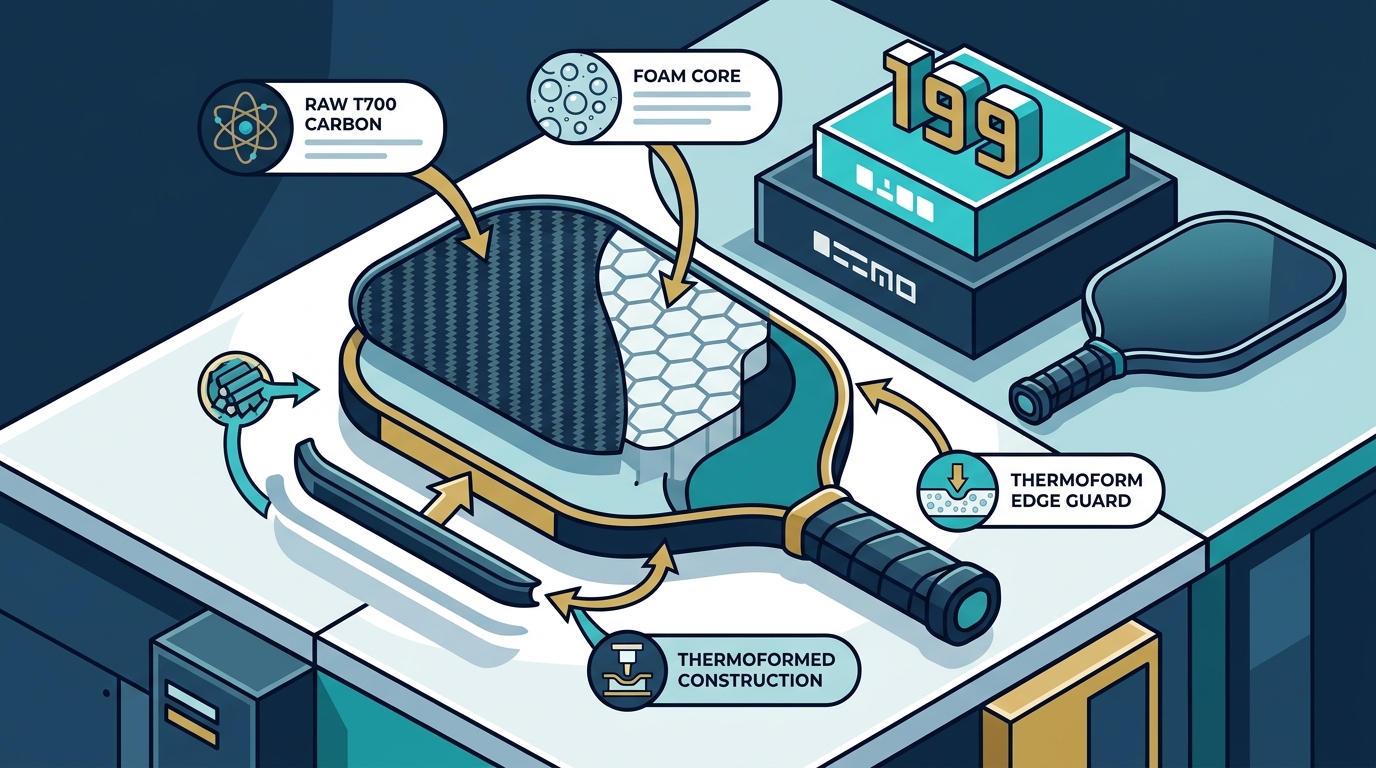
Polypropylene honeycomb remains the industry standard for responsiveness and control. However, foam-injected and full-foam cores have become the 2026 benchmark for balanced power and feel. Full-foam paddles pocket the ball on contact, giving you more dwell time to shape shots, while maintaining the top-end pop that aggressive players need.
3. Face Material
Raw Toray T700 carbon fiber is the gold-standard surface at every price point. It delivers consistent grit for spin and precise feedback on contact. Some paddles blend carbon fiber with fiberglass for added “pop”—fiberglass is more flexible and launches the ball with less effort, which suits beginners who haven’t developed full swing mechanics yet.
4. Twist Weight
Twist weight measures a paddle’s resistance to rotation on off-center hits. It is the true indicator of forgiveness and effective sweet-spot size. Look for published twist-weight numbers above 6.0 if consistency matters to you.
5. Surface Grit Longevity
All carbon fiber faces lose friction over time. Paddles using chemically etched “peel-ply” textures tend to hold their spin performance roughly twice as long as spray-on grit alternatives. Since replacing a paddle because its surface died is a hidden cost, grit longevity is a genuine value factor.
A Decision Matrix: Match Your Play Style to the Right Paddle Traits
Instead of handing you a single ranked list, use the matrix below to narrow your search based on how you actually play.
| Play Style | Priority Specs | Ideal Core | Face Preference | Example Paddles Under $200 |
|---|---|---|---|---|
| Control & Soft Game – you win points with dinks, resets, and placement | High twist weight, 16 mm+ core, plush feel | Full foam or 16 mm honeycomb | Raw carbon fiber | Honolulu J6CR, Volair Shift, Engage Alpha Pro |
| All-Court Balanced – you need both touch and drive capability | Moderate swing weight, balanced power-to-control ratio | Foam-injected honeycomb or multi-density foam | Carbon fiber or carbon/fiberglass blend | Bread & Butter Loco, Vatic Pro V-SOL Pro, Friday Aura Pro |
| Power & Offense – you attack with drives, speed-ups, and overheads | Low swing weight for hand speed, 14 mm core, high pop | 14 mm honeycomb or thin foam | Raw carbon fiber for spin on attacks | Ronbus Quanta R3, Bread & Butter Shogun, CRBN³ X 16MM |
| Beginner / Developing – you want forgiveness and room to grow | Large sweet spot, moderate weight (7.5–8.3 oz), comfortable grip | 16 mm honeycomb | Carbon/fiberglass blend | 11SIX24 Pegasus Jelly Bean, Vatic Pro Prism Flash, Warping Point Ascent |
Spotlight: Paddles Worth Investigating in Each Category
Control & Soft Game: Honolulu J6CR (~$200)
The Honolulu J6CR is widely regarded as one of the best full-foam paddles available. Its intricate core design with multiple layers and cutouts allows the paddle to absorb and transfer energy in a controlled way, producing a pronounced pocketing effect on contact. It maintains the top-end power that full-foam designs are known for while excelling at shaping the ball from the baseline and flicking shots at the kitchen line.
All-Court Balanced: Bread & Butter Loco (~$179–$199)
The Bread & Butter Loco is rated as the best overall paddle in May 2026 by Pickleheads after testing over 200 paddles, performing better than practically every other paddle while costing below $200. It delivers a plush, controlled feel with excellent dwell time for shot-shaping, strong spin capability, and enough power for aggressive overheads and drives. Reviewers note it works for players at every skill level.
Power & Offense: Bread & Butter Shogun (~$175)
The Shogun is an elongated paddle built for players who prioritize reach and offensive firepower. Its carbon fiber weave face generates impressive spin and power, and it’s being called a potential trendsetter for that material approach. Players who swing aggressively from the baseline will appreciate its drive-oriented design.
Beginner / Developing: 11SIX24 Pegasus Jelly Bean (~$99)
The Jelly Bean’s unique widebody shape creates one of the largest sweet spots in the market. Built with raw Toray T700 carbon fiber and fiberglass, it combines softness and precision with pop, giving newer players forgiveness on mishits while still delivering spin. The extra-long handle accommodates two-handed backhands, a stroke that more players are adopting.
Budget All-Rounder: Vatic Pro V-SOL Pro (~$99)
The V-SOL Pro features Gen 4 technology that is rare at this price point, making it competitive enough for tournament play. It mirrors the design language of paddles costing two to three times as much, and reviewers consistently describe it as one of the most polished sub-$100 options available in 2026.
The Hidden Costs Most Buyers Ignore
True value isn’t just the sticker price. Factor in these often-overlooked costs before committing:
- Grit degradation: A paddle whose spin surface dies after 60 hours of play needs replacing sooner. Choosing a paddle with durable, chemically etched grit saves money over a season.
- Arm health: Stiff, hollow paddles transmit high-frequency vibrations into your tendons. If a cheap paddle gives you elbow pain, you’ll spend the savings on physical therapy. Thicker cores (16 mm+) and foam construction act as shock absorbers.
- Moisture intrusion: In humid climates, non-sealed honeycomb edges can absorb moisture, adding weight and deadening response over time. Foam-injected perimeters seal the core and maintain consistent performance.
- Customization potential: A $10 roll of lead or tungsten tape at the 4 and 8 o’clock positions increases twist weight, expanding the effective sweet spot to near-premium levels. Paddles that accommodate customization extend their useful life.
How to Test Before You Buy
- Demo programs: Many online retailers and local clubs offer demo paddle programs. Play at least three full sessions with a paddle before deciding.
- The kitchen-line test: Spend 10 minutes dinking. If the paddle feels harsh or unpredictable on soft shots, it’s wrong for control play regardless of how good it drives.
- The fatigue test: Play for 90+ minutes. If your forearm or elbow aches afterward, the core is too thin or too stiff for your body.
- Weight check: Staying between 7.5 and 8.3 ounces generally delivers balanced performance. Lighter paddles favor quick hands; heavier ones add power but can cause fatigue.
Key Takeaways
- The $100–$200 tier is the performance sweet spot for most players in 2026. Premium paddles above $200 offer incremental gains that mainly benefit tournament-level competitors.
- Prioritize core thickness, face material, and twist weight over brand prestige or cosmetic design.
- Full-foam and foam-injected cores have moved from experimental to mainstream, delivering the best blend of power, control, and arm protection.
- Surface grit longevity and moisture resistance are hidden value factors that affect total cost of ownership.
- Use the play-style matrix above to narrow your options before reading individual reviews.
- Shop at Godfather Pickleball for curated, pro-tested selections across every price tier—with gear trusted by athletes and built for players at every level.
Frequently Asked Questions
Is there really a meaningful performance gap between a $100 paddle and a $250 paddle in 2026?
The gap has narrowed significantly. Brands like 11SIX24, Vatic Pro, and others now deliver specs at $100 that looked premium 18 months ago. Recreational and intermediate players often find that performance plateaus beyond the mid-tier range, meaning the extra $150 buys refinements only tournament players are likely to notice.
What does “twist weight” mean and why should I care?
Twist weight measures a paddle’s resistance to twisting when you hit the ball off-center. Higher twist weight means a larger effective sweet spot and more forgiveness on imperfect contact. In 2026, this metric has become one of the most important indicators of paddle quality, and transparent brands now publish it alongside traditional specs.
Are foam core paddles better than honeycomb?
Neither is universally “better.” Foam cores offer a plush feel with excellent dwell time and shock absorption, making them ideal for players who shape shots and value arm comfort. Honeycomb cores tend to be more responsive and snappy, suiting players who want immediate feedback and crisp pop. Many 2026 paddles use hybrid approaches—foam-injected honeycomb—to blend both characteristics.
How long does surface grit last on a carbon fiber paddle?
Most carbon fiber faces lose 20–30% of their friction after roughly 100 hours of play, regardless of price. Paddles with chemically etched peel-ply textures retain spin performance roughly twice as long as spray-on alternatives. Check reviews for grit durability comments before purchasing.
Where can I find high-quality pickleball paddles under $200?
Godfather Pickleball curates pro-tested paddles, shoes, and gear for players at every level. Their selection spans the value tier covered in this guide, making it easy to compare options and find the right fit for your game.