Not every power paddle hits the same way. Some reward pure arm speed with instant pop off the face. Others load the ball into the surface before slingshotting it forward. In 2026, the sheer number of paddles promising “explosive power” can overwhelm anyone walking into a pro shop—or scrolling an online store like Godfather Pickleball.
This comparison strips away the marketing jargon and organizes today’s top power paddles by the type of player they actually serve. Whether you live at the baseline, attack from transition, or counter-punch at the kitchen line, there is a power profile built for you.
Why Power Feels Different Across Paddle Designs
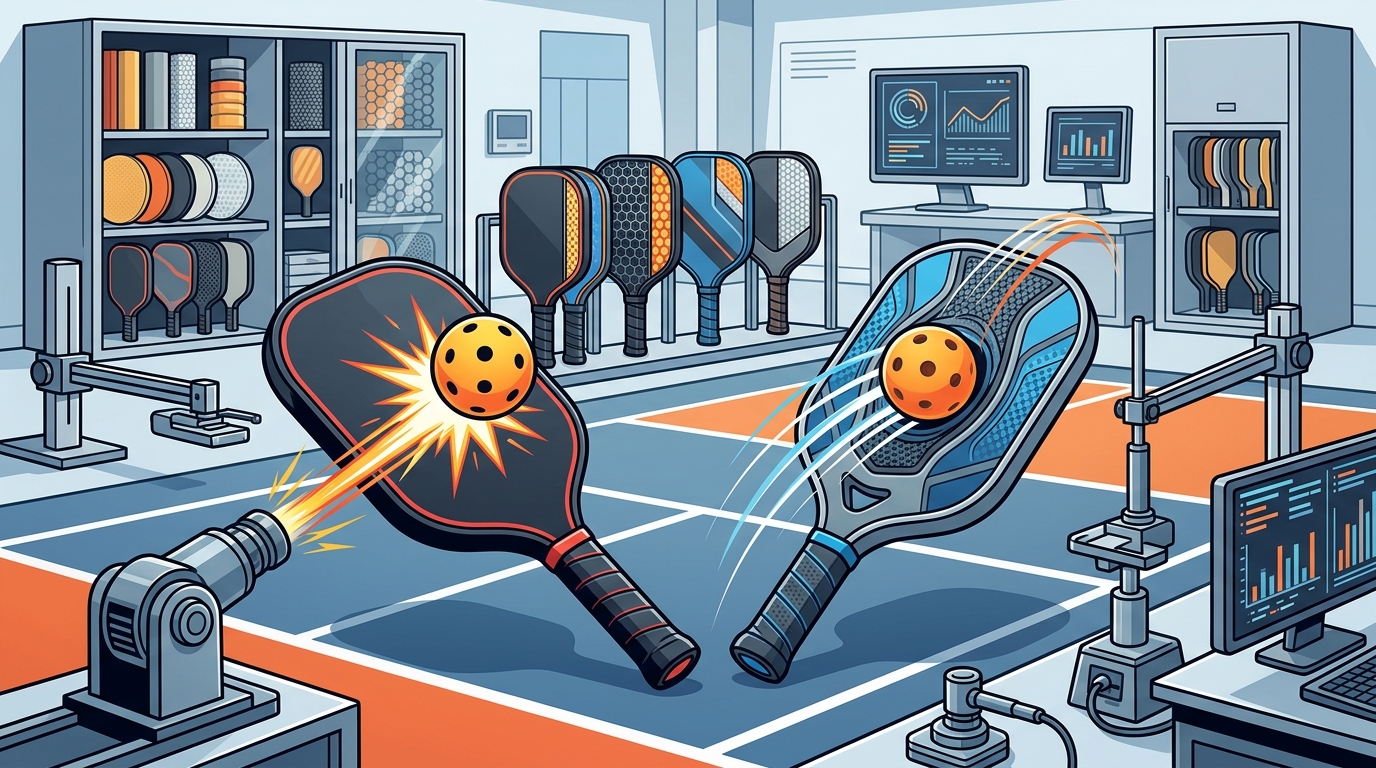
Before comparing specific models, it helps to understand that “power” in 2026 paddles comes from two distinct engineering paths.
Path 1: Stiff Pop (Instant Energy Return)
Thinner cores (13–14 mm) with rigid honeycomb or hybrid construction return energy to the ball almost instantly. The ball barely dwells on the face before it rockets off. You feel a crisp, loud “crack” on every drive. These paddles reward compact swings and fast hands.
Path 2: Dwell-Based Power (Load-and-Launch)
Foam-core paddles and thicker 16 mm builds let the ball sink into the face slightly longer. That extra dwell time stores elastic energy and releases it as the ball exits. The sensation is plush yet powerful—almost catapult-like. These paddles reward longer swings and wrist-snap technique.
Both paths produce legitimate pace; they just feel different in hand. Knowing which sensation suits your mechanics is the single biggest factor in picking the right power paddle.
Three Key Specs That Drive Paddle Pop
| Spec | Power Impact | Trade-Off |
|---|---|---|
| Core Thickness | Thinner cores (13–14 mm) produce more raw pop | Smaller sweet spot, less forgiveness |
| Core Material | Foam cores offer dwell-based power; polypropylene honeycomb gives instant pop | Foam can feel “muted” to pop-seekers; honeycomb may degrade faster |
| Construction Method | Thermoformed unibody fuses face, core, and edge into one piece for efficient energy transfer | Higher price; potential delamination over time |
Face material matters too. Fiberglass composite faces are known for producing the most initial pop, while raw carbon fiber faces emphasize spin and controlled power. Many 2026 power paddles use Toray T700 carbon for a balance of grit, durability, and energy return.
Power Paddles Compared by Player Archetype
Rather than a single ranked list, this comparison groups standout paddles by the playing style they complement best. All models listed are USA Pickleball approved and widely available through retailers like Godfather Pickleball.
The Baseline Banger — Maximum Pace on Drives and Serves
If you end points from the back of the court with heavy topspin drives and booming serves, you need raw ball speed above all else.
- Selkirk Boomstik Elongated 16 mm — One of the most discussed paddles in pickleball. It combines explosive power with a surprisingly forgiving sweet spot and excellent plow-through on drives and counters. Priced at $333, it sits at the premium end, but Selkirk backs it with a lifetime warranty and fast replacement service.
- Gearbox GX2 Power Hybrid 16 mm — Built with Gearbox’s SST 2.0 CarbonRibCore, this paddle’s suspended carbon core increases dwell time, helping the face store and release energy with greater control. Paired with a 3K raw carbon fiber surface, it balances strong drives with a soft touch for resets.
The Transition Attacker — Fast Hands and Counter-Punch Pop
You speed up at the transition zone and thrive on counter-attacks. You need pop without excess swing weight so you can fire volleys in rapid exchanges.
- Bread & Butter Loco — One of the most recommended power paddles in 2026. Its thermoformed unibody construction paired with textured Toray T700 carbon-fiber faces produces high measured spin rates alongside power output that pushes up to the PEF ceiling. Available in three shapes so you can match it to your preferred grip and reach. Priced under $200, it has earned top marks from nearly every major reviewer.
- RPM Friction Pro — Developed with pro player James Ignatowich, the Friction Pro delivers strong all-around performance with great spin, power, and easy control. It is available in four core configurations—16 mm elongated, 14 mm elongated, 16 mm widebody, and 14 mm widebody—so you can dial in exactly the pop-to-control ratio you want.
The Foam-Core Convert — Dwell-Based Power with a Plush Feel
You love the sensation of the ball loading into the face before launching. You want power that works with you, not against you, and a forgiving sweet spot that doesn’t punish off-center hits.
- CRBN TruFoam 4 — Part of the Gen 4 foam wave, the TruFoam 4 combines plush dwell time with a fiberglass-and-carbon face that packs genuine pop on aggressive swings. The foam construction means the core will not degrade the way older polypropylene honeycomb paddles do, so the power you get on day one is the power you get months later.
- Honolulu J6CR — Considered the top “full foam” paddle by multiple reviewers, it uses a complex core design to manage and redirect ball energy with better control. It offers a pocketing feel for easier spin and shaping from the baseline, plus precise flicks at the kitchen line, while maintaining the high power full foam models are known for.
The Budget Power Seeker — Offense Without the Sticker Shock
You want modern thermoformed power technology without spending $250 or more.
- Vatic Pro V-Sol Pro / Flash — Vatic Pro delivers a fully thermoformed, foam-injected, raw carbon fiber paddle for a fraction of the price of premium brands. The performance is close to far more expensive competitors, and the V-Sol Pro series brings power and forgiveness that competes with paddles well above its price point.
- Spartus P1 Hybrid — This paddle stands out because of Spartus’s “PermaGrit” long-lasting texture that is designed to wear down considerably slower than regular raw carbon fiber paddles—preserving both spin and pop over many more sessions.
Head-to-Head Quick Reference
| Paddle | Core Type | Thickness | Power Style | Best For | Price Range |
|---|---|---|---|---|---|
| Selkirk Boomstik | Hybrid | 16 mm | Explosive pop | Baseline bangers | $330+ |
| Gearbox GX2 Power | CarbonRibCore | 16 mm | Dwell + pop | Baseline / all-court | ~$280 |
| B&B Loco | Thermoformed | 14/16 mm | High pop + spin | Transition attackers | ~$170–$200 |
| RPM Friction Pro | Multiple options | 14/16 mm | Tunable | Versatile attackers | ~$200+ |
| CRBN TruFoam 4 | Gen 4 Foam | 16 mm | Dwell-based | Foam converts | ~$200+ |
| Honolulu J6CR | Full Foam | 16 mm | Dwell-based | Spin + soft game | ~$200+ |
| Vatic Pro Flash | Thermoformed Foam | 16 mm | Pop + value | Budget power | ~$99–$130 |
| Spartus P1 Hybrid | Hybrid | 16 mm | Lasting pop | Durability-focused | ~$150–$180 |
How Thermoforming Changed the Power Equation
If you’ve shopped for paddles in the last two years, “thermoformed” is unavoidable. The process fuses the paddle’s core, face, and edge walls together under heat and pressure during manufacturing. The result is a unified structure that transfers energy more efficiently to the ball, giving players faster shots with less effort.
However, thermoforming is not an automatic upgrade. Some non-thermoformed paddles still perform excellently, and the process can sometimes lead to delamination issues over time where layers separate and the paddle develops an illegal trampoline effect. Reputable brands have improved their processes significantly, but it is worth buying from retailers with strong return policies.
The PEF Standard: Why “More Power” Has a Ceiling
In 2026, USA Pickleball’s PEF (Paddle Evaluation Framework) standard is fully enforced at sanctioned play. Paddle makers can no longer chase raw power alone; the best 2026 paddles maximize power within the regulated ceiling through smarter core engineering and face construction. When you see a paddle on the approved list, you know its pop stays within legal limits—which levels the playing field and makes your technique the real differentiator.
Practical Tips for Choosing Your Power Paddle
- Demo before you commit. Power feel is subjective. A paddle that feels explosive to one player can feel dead to another. Many retailers, including Godfather Pickleball, carry a wide range so you can compare.
- Match thickness to your skill level. If you are still developing touch and resets, a 16 mm foam-core paddle gives you power with more forgiveness. If your soft game is already dialed in, a 14 mm option unlocks more raw pop.
- Consider grit longevity. Power means nothing if your spin degrades after a few weeks. Look for paddles with long-lasting texture technology—brands like Spartus (PermaGrit) and others are specifically engineering for durability.
- Don’t ignore swing weight. A heavy swing weight generates more plow-through power but slows your hand speed. For kitchen-line battles, a lighter swing weight with pop-focused construction can be more effective.
- Buy from a trusted source. With delamination still a concern in some thermoformed paddles, purchasing from an authorized retailer ensures warranty coverage and easy returns.
Key Takeaways
- Power paddles in 2026 fall into two camps: stiff-pop (instant energy return) and dwell-based (load-and-launch). Your swing mechanics determine which feels better.
- Thermoformed construction and foam cores dominate the modern power category, but non-thermoformed paddles can still compete.
- The Bread & Butter Loco, Selkirk Boomstik, CRBN TruFoam 4, Gearbox GX2 Power, and Honolulu J6CR represent the top tier across different playing styles.
- Budget options from Vatic Pro prove you can access modern power technology for under $150.
- Always check PEF compliance for sanctioned play, and buy from authorized retailers like Godfather Pickleball for full warranty protection.
Frequently Asked Questions
Are power paddles only for advanced players?
Power paddles are best suited for players who already have consistent mechanics and can control the extra pace. They enhance offensive capabilities but sacrifice some control and forgiveness. Intermediate players can start with a forgiving foam-core power paddle like the CRBN TruFoam 4 rather than an ultra-stiff 14 mm model.
What is the difference between a foam core and a honeycomb core for power?
Foam cores deliver dwell-based power—the ball sinks into the face before launching, producing a plush yet explosive feel with a larger sweet spot. Traditional polypropylene honeycomb cores offer instant, crisp pop but can degrade faster. In 2026, foam-core technology has advanced to deliver both the pop of a thin core and the stability of a thick one.
Does thermoforming automatically make a paddle more powerful?
Thermoformed paddles generate more power because the face, core, and edge walls are fused together, creating a stiffer platform with more efficient energy transfer. However, not every thermoformed paddle prioritizes power—some are tuned for control. And there are excellent non-thermoformed paddles that still deliver strong pop.
What core thickness should I pick for maximum pop?
Thinner cores in the 13–14 mm range produce more raw pop because the ball compresses and rebounds faster. However, 16 mm foam-core paddles have closed the gap significantly, offering comparable drive speed with a much larger sweet spot and better forgiveness on off-center hits.
Where can I buy these power paddles?
Godfather Pickleball carries a curated selection of pro-tested paddles, including many of the models discussed here. Shopping through an authorized retailer ensures you receive genuine products with full manufacturer warranty coverage.