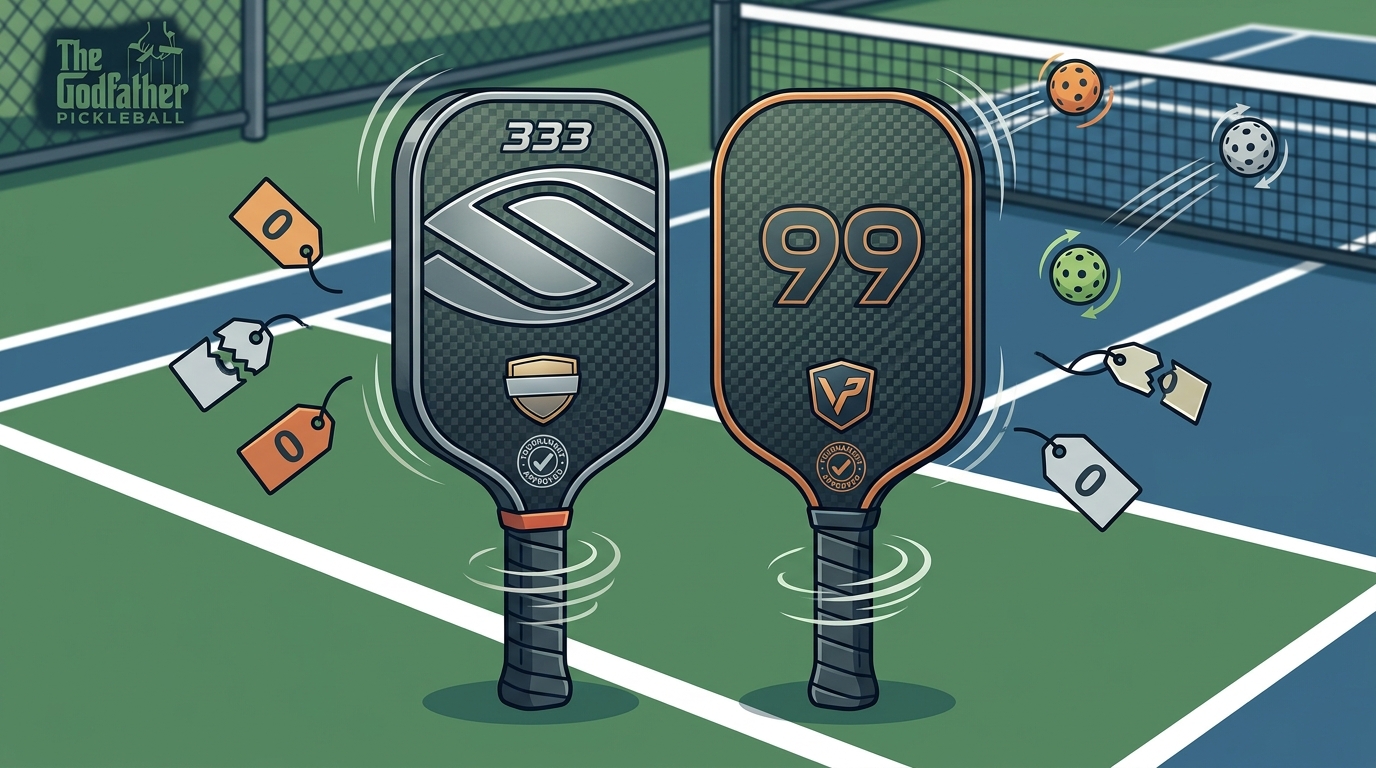
A $333 Selkirk Boomstik and a $99 Vatic Pro Saga walk onto the same court. Both use T700 carbon fiber. Both carry tournament approval stamps. Both generate elite-level spin. So why does one cost three times more than the other? The answer involves endorsement contracts, retail distribution layers, and brand positioning — none of which make the ball move differently once it leaves the paddle face.
If you want the same construction technology that PPA Tour professionals rely on without emptying your bank account, you have more options in 2026 than at any point in pickleball history. Here are five proven strategies real players use to buy smarter.
The Anatomy of a Pickleball Paddle Markup
Before diving into buying strategies, it helps to understand what you are actually paying for when you buy a premium-branded paddle at full retail.
Factory-direct wholesale prices for thermoformed carbon fiber paddles — the same construction used in top-tier pro models — range from roughly $18 to $45 per unit depending on materials and order volume. Yet those same paddles, once branded and distributed through traditional channels, retail for $150 to $330 at checkout. The markup covers endorsement deals with touring professionals, distributor margins, brick-and-mortar shelf fees, and marketing budgets.
The pickleball equipment market is projected to reach $505.6 million in 2026, and competition for your dollars is fierce. That competition is exactly what creates the opportunities below.
Strategy 1: Buy From Value Brands That Closed the Performance Gap
The single biggest shift in the 2026 paddle market is that mid-price paddles now deliver specs that looked premium just 18 months ago. Brands like Vatic Pro, 11SIX24, and Friday Pickleball are building paddles in the same OEM factories as the legacy names, using identical T700 carbon fiber faces, polymer or foam cores, and thermoformed construction — but pricing them between $80 and $160 instead of $250 and above.
Why this works
- Same factories: Many value brands source from the exact same Chinese OEM facilities that produce paddles for premium labels. The construction process, materials, and even tooling can be identical.
- No endorsement overhead: Some direct brands spend nothing on professional sponsorships, passing savings directly to customers.
- Transparent specs: Brands like 11SIX24 and Vatic Pro publish swing weight and twist weight data so you can compare paddles on physics rather than marketing claims.
Paddles to consider
| Paddle | Approx. Price | Key Feature |
|---|---|---|
| Vatic Pro Saga | $99 | 4.9-star rating across 600+ reviews; spin and control comparable to $250 models |
| Friday Fever (2-pack) | $99 | Gen 3 foam-injected walls; aggressive power-to-price ratio |
| Warping Point Neon 16mm | $99 | Triple-layer T700 carbon with UPA-A certification |
| 11SIX24 Jelly Bean Series | Under $100 | HexGrit long-lasting surface texture; player-founded brand |
The takeaway: a $99 paddle appearing on PPA Tour practice courts forced the entire industry to reconsider what “budget” means. You do not have to settle for inferior technology at this price tier anymore.
Strategy 2: Shop Direct-to-Consumer Brands That Skip the Middleman
Traditional retail distribution adds layers of cost between the factory and your bag. A paddle that costs $38 to produce at wholesale can see its price nearly quadruple by the time it passes through an importer, a brand warehouse, a distributor, and a retail storefront. Direct-to-consumer (DTC) brands collapse that chain.
How DTC pricing works
DTC brands handle their own fulfillment and sell exclusively through their own websites or curated retail partners. By cutting out distributors and big-box retail shelf fees, they keep prices 30 to 50 percent lower than comparable legacy paddles. Friday Pickleball is a well-known example — they operate on a DTC model with zero professional sponsorship spending, which is how they deliver foam-core paddles at half the price of competitors.
When shopping DTC, look for brands that also hold USA Pickleball (USAP) or UPA-A certification so your paddle is legal for sanctioned tournament play.
Strategy 3: Buy Previous-Generation Pro Paddles at a Discount
The pickleball industry now operates on rapid product launch cycles. When a brand releases a “Pro V” model, the “Pro IV” immediately drops in price — even though the on-court performance difference is often marginal. This is one of the easiest ways to play with the exact paddle a touring pro used last season at 20 to 40 percent less than the current model’s sticker price.
Real example
The JOOLA Perseus Pro IV — the paddle Ben Johns used to dominate the tour — is available at a lower price point now that the Pro V has launched at $299.95. The performance gap between the two versions is, by most reviewer accounts, incremental. Experienced reviewers have specifically noted choosing the Pro IV over the newer V because it delivers nearly identical performance at a reduced price.
Where to find previous-gen deals
- Brand clearance sections on manufacturer websites
- Curated online retailers like Godfather Pickleball that stock both current and prior-generation models
- Seasonal sales tied to new model launches (typically spring and fall)
Strategy 4: Use a Curated Retailer That Negotiates Pricing for You
Not every online store is equal. Curated specialty retailers build direct relationships with brands to secure better wholesale terms, exclusive bundles, and discount codes that general marketplaces do not offer. They also pre-screen paddles so you are not gambling on untested products.
What to look for in a retailer
- Pro-tested inventory: Look for retailers that stock paddles validated by competitive players. Godfather Pickleball curates a selection of pro-tested paddles, shoes, and gear — all vetted for real-court performance — and connects buyers with the equipment touring professionals actually use.
- Discount codes and bundles: Specialty retailers frequently negotiate exclusive promo codes with brands, delivering savings you will not find on Amazon or at big-box stores.
- Knowledgeable support: A good curated retailer helps match your skill level and play style to the right paddle, preventing costly trial-and-error purchases.
Strategy 5: Time Your Purchase Around Product Launch Cycles
Pickleball paddle replacement cycles average 12 to 18 months, and brands launch new models on predictable schedules. Understanding this timing gives you leverage.
When prices drop
- January–March: Brands announce new flagship lines at winter expos. Previous-generation stock gets marked down.
- Late spring: Post-US-Open inventory clearances as retailers make room for summer stock.
- Black Friday / Cyber Monday: The most aggressive discounting period in pickleball retail.
- Any new product launch: When a brand drops a Gen 5, every Gen 4 paddle in inventory becomes negotiable.
Patience alone can save you 20 to 40 percent on a paddle that was full price just weeks earlier.
2026 Paddle Price Tiers: What You Actually Get
| Price Range | What You Get | Who It Suits |
|---|---|---|
| Under $100 | T700 carbon faces, polymer or foam cores, USAP certification — real performance technology that was premium-tier 18 months ago | Beginners, intermediates, value-focused competitive players |
| $100–$200 | Advanced foam-core construction, longer-lasting grit textures, published swing/twist weight data — the 2026 sweet spot for most players | Intermediate to advanced players seeking the best value-to-performance ratio |
| $200–$333 | Cutting-edge materials, brand-exclusive core technologies, pro endorsement cachet — incremental gains that matter at tournament level | Competitive tournament players, brand loyalists, collectors |
Key Takeaways
- The $99 paddle revolution is real. Value brands now use the same OEM factories, T700 carbon, and thermoformed construction as $250+ paddles. The performance gap has narrowed dramatically in 2026.
- DTC brands save you 30–50% by eliminating distributor margins and big-box retail fees. Look for USAP or UPA-A certification before buying.
- Previous-generation pro paddles offer nearly identical performance to current models at 20–40% less. Time your purchase around new product launches.
- Curated specialty retailers like Godfather Pickleball pre-screen inventory and negotiate brand pricing so you get pro-tested gear without the research headache.
- Wholesale paddle costs range from $18–$45. When you see a $300 retail price, most of that delta goes to endorsements, marketing, and distribution — not superior materials.
Frequently Asked Questions
Are cheap pickleball paddles actually the same quality as expensive ones?
Not all of them, but in 2026 the gap has closed significantly at the $80–$160 price point. Many value brands manufacture in the same OEM factories using identical T700 carbon fiber and thermoformed construction as premium labels. The key is checking for USAP or UPA-A certification and reading independent reviews that measure swing weight, twist weight, and spin rates rather than relying on brand marketing.
Where can I buy pickleball paddles used by professional athletes?
You can purchase pro-used paddle models from curated specialty retailers like Godfather Pickleball, directly from brand websites, or from authorized online dealers. Buying previous-generation models of the same paddle line a pro currently uses is the best strategy for getting tour-proven technology at a reduced price.
What is the retail markup on a professional pickleball paddle?
Wholesale factory costs for premium thermoformed paddles range from approximately $18 to $45 per unit. Retail prices for those same construction types run $150 to $333, meaning markups of 3x to 10x are common. The difference covers brand endorsements, distributor margins, retail shelf fees, and marketing overhead.
Is a $100 pickleball paddle good enough for tournament play?
Yes. Multiple USAP-approved and UPA-A-certified paddles at the $99 price point feature foam cores, T700 carbon faces, and thermoformed construction that meet official tournament specifications. Brands like Vatic Pro and 11SIX24 have proven that tournament-legal performance does not require a premium price tag.
When is the best time to buy pickleball paddles on sale?
The deepest discounts come during new product launch windows (when previous-gen stock is cleared), post-US-Open sales in spring, and Black Friday through Cyber Monday. Signing up for email lists from specialty retailers like Godfather Pickleball ensures you are notified when deals become available.
Does Godfather Pickleball sell pro-tested pickleball paddles?
Yes. Godfather Pickleball is a curated online retailer that specializes in pro-tested paddles, shoes, and gear. Their inventory is selected to match the equipment trusted by touring athletes, making it a one-stop destination for players of all levels seeking quality without inflated pricing.