
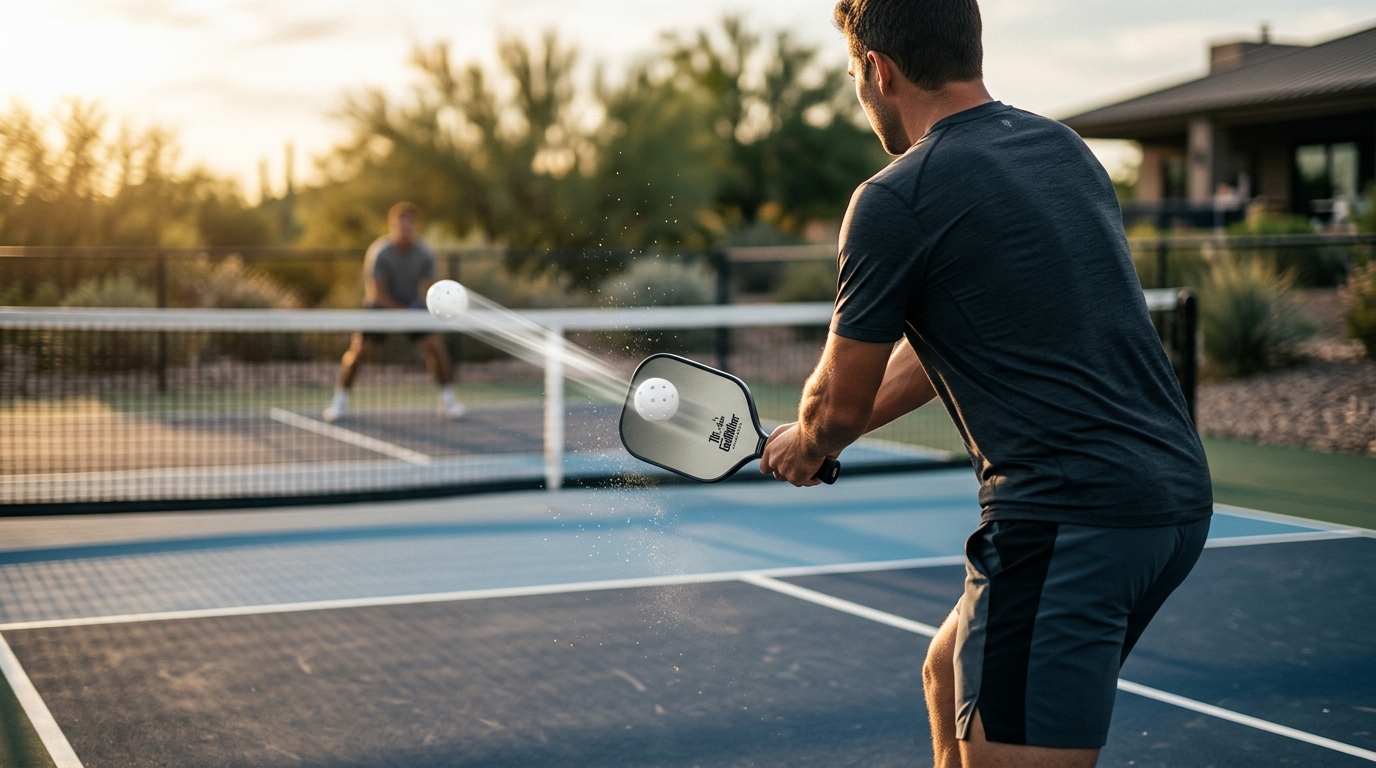
You already know the feeling: a full-swing drive that explodes off the paddle face and paints the baseline before your opponent can react. That sensation—pop—is what separates a paddle that merely hits from one that punishes. But engineering that explosive energy return is not random; it is the result of specific construction choices you can learn to evaluate yourself.
This tutorial walks you through each variable that creates power, shows you how to test paddles on court, and explains how to fine-tune your setup for maximum offensive output—all without sacrificing the control you need at the kitchen line.
Step 1 — Understand the Four Construction Pillars of Power
Every powerful paddle combines the same four engineering ingredients in varying proportions. Learn them once and you will be able to evaluate any paddle on the wall.
Pillar A: Core Thickness and Material
The core is the engine room. Thinner cores—typically around 13 mm—flex less at impact, which means more energy is transferred directly into the ball for higher velocity. Thicker 16 mm cores absorb more energy, improving touch but reducing raw pop. Polymer honeycomb remains the standard core material, but newer foam-injected and full-foam cores are reshaping the power landscape.
Full foam cores produce a firm contact feel with big power on full swings, while honeycomb cores with a foam perimeter ring blend crispness with stability. In recent reviewer testing, foam paddles from brands like Honolulu, Selkirk, and Friday have topped power rankings thanks to their energy-return characteristics.
Pillar B: Face Stiffness
The face is where the ball meets your intention. Raw carbon fiber faces—especially those using Toray T700 or 3K weaves—are stiffer than fiberglass and return more energy to the ball while also adding spin thanks to their naturally gritty texture. Fiberglass faces flex more, absorbing energy that could otherwise go into the shot.
Pillar C: Thermoformed Unibody Construction
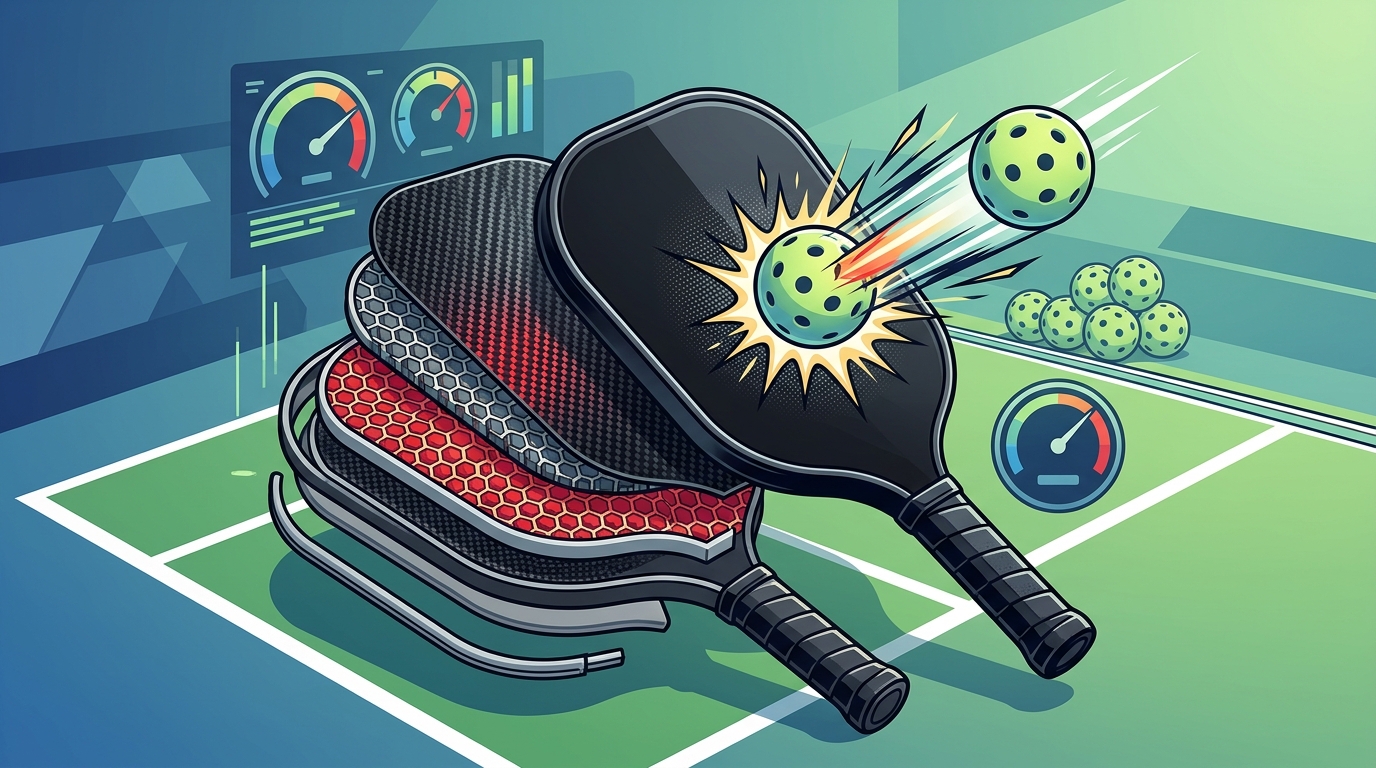
Thermoforming fuses the carbon fiber faces and core into a single, rigid structure under heat and pressure. The resulting unibody design is significantly stiffer than traditionally glued paddles, and that added stiffness translates directly into power. Foam injection around the perimeter walls after thermoforming adds even more stability, increases swing weight, and dampens vibration.
Pillar D: Weight Distribution and Swing Weight
Raw paddle weight matters, but where the weight sits matters more. Swing weight—measured in kg·cm²—captures how heavy the paddle feels during a stroke. Power-oriented paddles generally have a swing weight above 115–125 kg·cm², concentrating mass in the head for a heavier impact without making the whole paddle feel unwieldy.
Step 2 — Learn to Read the Spec Sheet
Paddle companies publish varying amounts of data. Here is how to decode the numbers that matter most for power.
| Spec | Power Sweet Spot | Why It Matters |
|---|---|---|
| Core thickness | 13–14 mm | Less flex = more energy return |
| Paddle weight | 8.0–8.4 oz | Heavier contact = more force |
| Swing weight | 115–130 kg·cm² | Head-heavy feel amplifies drives |
| Face material | Raw carbon fiber (T700, 3K) | Stiffer face, higher rebound |
| Construction | Thermoformed unibody | Rigid platform maximizes energy transfer |
| Shape | Elongated (16.5″+) | More reach and leverage on swings |
If a paddle hits four or more of these benchmarks, it is likely an aggressive, power-oriented option.
Step 3 — Run These Three On-Court Power Tests
Specs tell only part of the story. Use these drills to evaluate pop in a real-world setting.
Test A: The Standing Drive Test
Stand at the baseline with your feet planted. Hit 20 flat drives at 75 % effort. A true power paddle will push the ball deep into the opposite court even without a full wind-up. If the ball consistently lands short, the paddle is absorbing too much energy.
Test B: The Hands-Battle Punch Volley
Stand at the kitchen line and trade punch volleys with a partner. Power paddles should produce fast, penetrating counters with compact swings. If you find yourself having to take a full swing to keep pace, the paddle lacks pop at short contact.
Test C: The Overhead Finish
Feed yourself high lobs and hit overheads. A power paddle turns even moderately swung overheads into authoritative putaways. If you have to muscle the ball to finish, you need more head weight or a stiffer core.
Step 4 — Customize Your Setup for Extra Pop
Even a good power paddle can be dialed up with simple modifications.
Lead Tape Placement
Adding 0.3–0.5 ounces of lead tape to the 3-o'clock and 9-o'clock positions on the paddle head increases swing weight, stability, and power. Experienced reviewers have noted that lead tape can transform an underwhelming paddle into an aggressive weapon—one tester added 0.4 oz around the edge guard and called the difference dramatic.
Grip Weight Counterbalance
If lead on the head makes the paddle feel unwieldy, add a small strip inside the handle to raise the overall weight while keeping balance manageable. This adds stability on contact without sacrificing reaction speed at the net.
Overgrip Thickness
A thicker overgrip adds a gram or two and improves wrist stability, helping you swing confidently on hard drives. It is a subtle change, but every gram and every degree of wrist stability matter when you are chasing maximum power.
Step 5 — Power Paddles Worth Testing in 2026
The paddle market moves fast. Here are categories of paddles that are earning high marks from independent testers this year, organized by the type of power they deliver.
Full-Foam Pop Machines
- Selkirk Boomstik — One of the most powerful paddles on the market thanks to its foam core, paired with the Infinigrit surface for spin. Backed by a lifetime warranty.
- Friday Aura Pro — A full-foam paddle with a rubber dampening ring that softens the harsh feel some foam paddles produce, while still delivering big pop in hands battles and on full swings.
- Honolulu J6CR — Considered a top full-foam option with a multi-density core design that manages and redirects ball energy with better control than many foam competitors.
Thermoformed Power-and-Spin Hybrids
- Bread & Butter Loco — An all-rounder that still packs serious punch. Thermoformed unibody construction with textured Toray T700 faces produces high spin rates and power output that pushes right up to regulatory ceilings.
- CRBN Foam Models — Huge spin, real power, and dwell time that lets advanced players shape every shot while still finishing aggressively.
Stiff-Core Pop Specialists
- Six Zero Black Opal — A true power paddle for advanced players (4.5+) that excels at shot-shaping with shorter, whippy strokes. The sweet spot is smaller, so touch is a prerequisite.
- Gearbox GX2 Power Hybrid 16 mm — Features a suspended core design that extends ball contact time while delivering consistent, efficient power and a large sweet spot.
Aggressive All-Court Options
- RPM Friction Pro — Designed with pro James Ignatowich, it combines strong spin, power, and controllability across four core configurations.
- Franklin C45 Dynasty 16 mm — Used by pros like Hayden Patriquin and Anna Leigh Waters, this series balances explosive drives with enough feel for competitive doubles.
You can explore many of these paddles and other pro-tested power options at Godfather Pickleball, where gear is curated specifically for players who want to elevate their offensive game.
Step 6 — Avoid These Power-Killing Mistakes
- Choosing a paddle that is too heavy overall. A 9+ oz paddle might sound powerful, but if you cannot swing it quickly, you lose racket-head speed—and speed is the real engine of power.
- Ignoring grip size. A grip that is too small forces you to squeeze harder, creating tension that slows your swing. A properly fitted grip lets you stay loose and whip through contact.
- Skipping the break-in period. Many foam-core paddles reach their optimal power window after several hours of play. Test a new paddle for at least 5–10 sessions before judging its pop.
- Confusing loudness with power. A loud crack does not always equal ball speed. Some of the most powerful modern paddles are surprisingly quiet because foam and polymer cores dampen sound while efficiently returning energy.
- Neglecting grit longevity. As the textured surface wears down, a power paddle loses spin, which makes it harder to control at high speed. Look for paddles with longer-lasting grit textures so your power remains usable for months.
Key Takeaways
- Power is a system: core thickness, face stiffness, thermoformed construction, and swing weight all work together.
- A raw carbon fiber face on a thermoformed unibody with a 13–14 mm core is the blueprint for maximum pop.
- Full-foam cores are dominating the 2026 power conversation—but honeycomb hybrids still compete at the top.
- On-court testing (drives, punch volleys, overheads) is more reliable than spec sheets alone.
- Lead tape is the simplest, cheapest power upgrade available to any player.
- Grit longevity matters—once spin fades, controlling a power paddle gets much harder.
- Browse curated power paddles at Godfather Pickleball for pro-tested options at every price point.
Frequently Asked Questions
What makes a pickleball paddle feel powerful?
Power comes from stiffness, swing weight, and energy return. Thermoformed unibody construction, raw carbon fiber faces, and thinner cores (13–14 mm) all contribute to a stiffer platform that returns more energy to the ball on contact. Foam injection around the edges adds further stability and a larger sweet spot for consistent hard swings.
Is a foam core or honeycomb core more powerful?
Full foam cores tend to produce a firm, pop-heavy contact feel, while honeycomb cores deliver a crisper, more immediate energy return. Some current designs—like the Honolulu J6CR and Friday Aura Pro—combine both approaches using a foam core with a rubber or EVA perimeter ring for a balance of power and touch.
Does a thinner core always mean more power?
In most cases, yes. A 13 mm core flexes less at impact than a 16 mm core, sending more energy back into the ball. The trade-off is a smaller sweet spot and less forgiveness on off-center hits, which is why many competitive players settle on 14 mm as the middle ground between pop and playability.
Can lead tape increase a paddle's power?
Absolutely. Adding 0.3–0.5 ounces of lead tape to the head of the paddle increases swing weight and stability, producing more force at impact. Even a small amount of strategically placed lead can add noticeable depth to drives and authority to overheads.
How does thermoforming affect paddle power?
Thermoforming fuses the face sheets and core into a single rigid unibody under heat and pressure. This process makes the entire paddle much stiffer, meaning less energy is lost to flex and more is transferred into the ball. It is one of the biggest power-related advances in modern paddle construction.
What swing weight should I look for in a power paddle?
Most power-focused paddles fall in the 115–130 kg·cm² swing weight range. Higher swing weight means more momentum at contact, but it can reduce maneuverability. If you play a lot of net exchanges, aim for the lower end of that range; if you are a baseline driver, go higher.
Where can I buy power pickleball paddles?
Godfather Pickleball offers a curated collection of pro-tested paddles, shoes, and gear for players of all levels. It is a one-stop shop built specifically for pickleball enthusiasts who want equipment trusted by athletes.